

When infection triggers the immune system to attack the brain's basal ganglia — a mechanism called molecular mimicry — it produces a sudden, severe cluster of neuropsychiatric symptoms that most providers misidentify as behavioral, psychiatric, or parenting problems. Month 1 gives parents the biological framework, clinical vocabulary, and documentation tools to understand what actually happened and advocate effectively for the evaluation their child needs.
Goal: Help families build the biological understanding and documentation foundation that transforms their observations from a parent's account into organized clinical evidence — ending the cycle of dismissal and directing limited time and resources toward the medical evaluation that can produce real answers.
📋 What This Month Is About
PANS (Pediatric Acute-onset Neuropsychiatric Syndrome) and PANDAS (Pediatric Autoimmune Neuropsychiatric Disorders Associated with Streptococcal Infections) are documented medical conditions in which an immune response — triggered by infection — disrupts a specific region of the brain, producing a sudden, severe cluster of neuropsychiatric symptoms that parents describe as a switch being flipped overnight. Month 1 gives parents the biological framework that explains every symptom in their child's picture, the clinical vocabulary that changes what happens in provider appointments, and the documentation tools that transform their observations from a parent's account into organized medical evidence.
If your child changed almost overnight — consumed by hand-washing rituals they cannot stop, exploding in rages that end as abruptly as they begin, regressing to behaviors they outgrew years ago, refusing to let you leave the room — and every provider has told you it is anxiety, a phase, or a parenting problem, this month is the beginning of the explanation you have been searching for. What you observed was real. What happened to your child has a biological name, a documented mechanism, and a clear research foundation: an immune response triggered by infection attacked a specific region of the brain, disrupting the systems that regulate thought, emotion, movement, and behavior. That is not a behavioral problem. It is a medical event — and understanding it is the first step toward getting your child the evaluation and treatment they actually need.
This month does not require any prior medical knowledge. It is designed specifically for parents who are still in the early stages — still trying to understand what happened, still being dismissed, still questioning whether what they observed was as serious as it felt. You will leave Month 1 with a biological framework that explains every symptom in your child's picture, a clinical vocabulary that changes what happens in provider appointments, and the documentation tools that transform your observations from a parent's account into organized medical evidence. Every minute spent on the wrong explanation is a minute not spent on the right one — and this month helps you stop losing those minutes.
This material is for educational purposes only and is not medical advice. It is not intended to diagnose, treat, cure, or prevent any condition. Always consult a licensed healthcare professional regarding medical concerns, medications, supplements, testing, or treatment decisions for your child. If these previews help you understand what happened to your child and find the right words to explain it, the Spectrum Care Hub Learning Community delivers the full toolkit for putting everything covered here into action.
Executive Summary
Month 1, "What Just Happened to My Child? — Understanding PANS/PANDAS From the Ground Up," builds the biological and advocacy foundation that every subsequent month depends on, covering the full clinical picture of Pediatric Acute-onset Neuropsychiatric Syndrome (PANS) and Pediatric Autoimmune Neuropsychiatric Disorders Associated with Streptococcal Infections (PANDAS), the immune mechanism that drives them, the specific brain region that is disrupted, and the documentation and communication frameworks that transform a parent's observations into clinical evidence. Core concepts — including how immune antibodies produced to fight strep can cross-react with brain tissue through a process called molecular mimicry, why every symptom in the PANS/PANDAS cluster maps directly to a disrupted function of the basal ganglia, and why the condition is so consistently dismissed by providers who were never trained to recognize it — give parents not just an explanation but a framework they can use in every clinical conversation from this point forward. Every lesson includes printable tools — symptom documentation records, illness and trigger timelines, appointment preparation trackers, and biological symptom translation guides — designed to help families arrive at every appointment with organized, specific, dated evidence that gets taken seriously rather than dismissed. This month stands alone as a complete orientation for families at the beginning of the diagnostic process, and it provides the biological and advocacy infrastructure that all subsequent months build on directly.
What it covers:
Why it matters:
For parents who have spent weeks or months being told their child's sudden, severe changes are anxiety, a phase, or a parenting problem, this lesson delivers the biological explanation that finally makes sense of everything they have been watching. Understanding that the symptom cluster has a specific, documented biological source changes the nature of every provider conversation — and helps families stop spending time pursuing behavioral explanations for what is fundamentally a medical event. The documentation tools in this lesson also give parents a structured way to capture the onset story in the format that carries the most clinical weight.
What it covers:
Why it matters:
Many families lose months — and significant money — when a negative rapid strep test is used to close the diagnostic investigation entirely. Understanding the difference between a rapid swab and a complete strep antibody workup, and knowing that PANS is a legitimate diagnosis even when no trigger is identified, helps families keep the investigation moving rather than accepting a premature dead end. The illness and trigger timeline tool in this lesson has helped many families surface a pattern that had been invisible — connecting infections to behavioral changes in a way that changes the entire direction of care.
What it covers:
Why it matters:
A parent who understands molecular mimicry does not need to convince a provider that PANS/PANDAS is real — they can ask specific, biologically grounded questions that demonstrate clinical literacy and shift the dynamic of the appointment entirely. Understanding why the relapsing-remitting pattern happens also equips parents to make the case for proactive treatment rather than reactive flare management — protecting their child from the compounding damage of repeated untreated immune events, and protecting the family from the ongoing financial and emotional cost of emergency-mode care.
What it covers:
Why it matters:
When a parent can connect every symptom their child is experiencing to a specific disrupted function of the basal ganglia, the conversation in a provider's office changes fundamentally — from "my child is having behavioral problems" to "the neuroinflammation in the basal ganglia is disrupting multiple regulatory functions simultaneously." That shift in framing produces a different clinical response. It also helps parents stop spending on behavioral interventions during active flares when the biology makes those interventions significantly less effective than they would be during a stable period.
What it covers:
Why it matters:
The documentation tools in this lesson exist because parent observations in PANS and PANDAS are primary diagnostic evidence — explicitly recognized as such in the published clinical guidelines — but are routinely underweighted when delivered verbally. A parent who arrives at an appointment with a completed written observation record, a dated video, and a provider response tracker is a parent who is taken seriously rather than reassured and sent home. The difference between those two outcomes is often the difference between months of additional delay and the beginning of real answers.
When neuroinflammation disrupts the basal ganglia, it produces a symptom cluster that spans OCD, tics, rage, emotional transformation, sleep, eating, urinary function, and motor control simultaneously — and because these symptoms cross multiple medical specialties, they are almost always evaluated in isolation rather than recognized as a single biological event. Month 2 teaches parents to identify every domain, understand the biological mechanism behind each symptom, distinguish flares from baseline, and capture the full picture in structured documentation that clinicians can act on immediately.
Goal: Equip families to recognize, name, and document the complete PANS and PANDAS symptom picture — across behavioral, emotional, physical, and functional domains — so that no provider encounter is spent explaining symptoms in isolation and every appointment moves the clinical conversation forward.
📋 What This Month Is About
Recognizing PANS and PANDAS symptoms means understanding that what looks like a collection of unrelated behavioral, emotional, and physical problems is actually a single biological event: neuroinflammation disrupting the brain circuits that regulate thought, emotion, movement, eating, sleep, urinary function, and motor control — all at the same time. Month 2 teaches parents to identify every major symptom category in the PANS and PANDAS presentation, understand the biological mechanism behind each one, distinguish a flare from a working baseline, and build the kind of structured documentation that moves a clinical conversation from observation to action.
If your child is displaying symptoms that shift from one day to the next — compulsive rituals that appeared overnight, explosive rages that end with your child confused and exhausted, a personality that no longer resembles the child you knew three months ago, handwriting that has deteriorated from third-grade level to something unrecognizable, bedwetting that returned years after they were fully trained — and the explanations you have been given range from anxiety to behavioral problems to bad parenting, you are not imagining the pattern. What you are observing is a coherent biological event: neuroinflammation disrupting specific brain circuits that regulate thought, emotion, movement, eating, sleep, urinary function, and motor control simultaneously. Each symptom is readable. Each one maps to a disrupted function. And the pattern they form together — the cluster, the timing, the relapsing-remitting course — is the clinical signature that separates PANS and PANDAS from every other explanation your child has been given. This month teaches you to read that signature across every domain it touches, so that no symptom goes unnamed and no appointment is spent chasing the wrong explanation.
Month 2 builds directly on the biological and advocacy foundation established in Month 1. Where Month 1 explained what PANS and PANDAS are, how the immune system attacks the basal ganglia, and why the medical system so consistently fails to recognize it, Month 2 moves into the specific, observable reality of living with these conditions — the full symptom picture across behavioral, emotional, physical, and functional domains, the difference between a flare and a baseline, and the tracking skills that turn raw parent observations into structured clinical evidence. Families who complete this month will be able to identify every major symptom category in the PANS and PANDAS presentation, distinguish biologically driven symptoms from the behavioral and psychiatric labels they are frequently misassigned, and walk into their next provider appointment with organized, specific, dated documentation that produces a clinical response rather than reassurance and a follow-up in three months.
This material is for educational purposes only and is not medical advice. It is not intended to diagnose, treat, cure, or prevent any condition. Always consult a licensed healthcare professional regarding medical concerns, medications, supplements, testing, or treatment decisions for your child. If these previews help you recognize and document the full scope of what your child is experiencing, the Spectrum Care Hub Learning Community delivers full trackers and templates for implementation.
Executive Summary
Month 2, "Recognizing the Symptoms — Learning to See What Others Miss," equips families to identify, understand, and document the complete PANS and PANDAS symptom picture — from the sudden-onset OCD that is neurologically distinct from typical childhood OCD, through the tics, rages, and developmental regression that are consistently misread as behavioral problems, to the emotional transformation that reshapes a child's personality, the physical symptoms that most providers never connect to the neuropsychiatric picture, the critical distinction between a flare and a working baseline, and the structured tracking methods that convert a parent's daily observations into the kind of organized clinical evidence that drives diagnostic and treatment decisions. One of the most damaging realities these families face is that symptoms crossing multiple medical categories get evaluated in isolation — the OCD goes to the psychiatrist, the tics go to the neurologist, the bedwetting goes to the urologist, the school regression triggers a special education evaluation — and no single provider sees the biological event connecting all of them. Every lesson includes printable tools — symptom documentation records, rage episode logs, flare recognition checklists, weekly symptom trackers, appointment preparation summaries, and medical timeline builders — designed to help families present the complete clinical picture in one organized, portable format that any provider can use immediately.
What it covers:
Why it matters:
Most families encounter OCD for the first time through their child's PANS or PANDAS onset, and the severity and strangeness of the symptoms make it nearly impossible to explain to providers, teachers, or family members who have never seen immune-driven OCD before. Understanding that this OCD has a biological mechanism — and that it behaves differently from the OCD that most mental health professionals were trained to treat — changes the nature of every conversation about your child's care. It helps families avoid months of behavioral therapy directed at the symptom rather than the cause, protecting both the child's recovery time and the family's financial resources.
What it covers:
Why it matters:
Tics, rage, and regression are the symptoms most frequently misread by schools, pediatricians, and family members — tics are dismissed as habits, rage is treated as a discipline problem, and regression triggers developmental evaluations that can take months and lead away from the correct diagnosis. A parent who can explain the biological basis of each symptom and present specific, dated documentation of the pattern — including the critical temporal connection to illness — shifts the conversation from behavior management to medical evaluation. That shift can save families months of misdirected treatment and protect a child from the compounding harm of an unaddressed immune process.
What it covers:
Why it matters:
Emotional symptoms are the most likely to be attributed to family environment, parenting, or primary psychiatric conditions — and the most likely to produce referrals that lead away from the correct diagnosis. When a child's sudden, severe separation anxiety is treated as an attachment issue, or their emotional lability is diagnosed as bipolar disorder, or their personality transformation is attributed to trauma, the biological cause continues unchecked while the child receives treatment that does not address it. Understanding the neurological basis of these symptoms helps families advocate for evaluation of the immune mechanism rather than accepting psychiatric labels that do not account for the onset pattern or the full symptom cluster.
What it covers:
Why it matters:
Physical symptoms are the most likely to be evaluated in isolation by providers who do not have the PANS and PANDAS framework — the bedwetting goes to the urologist, the eating restriction triggers an eating disorder evaluation, the sleep problems produce a melatonin recommendation — and the connection to the neuropsychiatric picture is never made. A parent who understands that every one of these physical symptoms maps to a specific mechanism of basal ganglia and autonomic disruption can present them as part of the syndrome rather than as separate problems, saving the family from fragmented specialist visits that each miss the unifying diagnosis.
What it covers:
Why it matters:
Without the language and framework for distinguishing flares from bad days and identifying a working baseline, families either live in constant alarm — treating every difficult moment as a crisis — or miss the early warning signs of a genuine flare until symptoms have escalated to the point where more aggressive intervention is required. Understanding the relapsing-remitting pattern also protects families from the emotional devastation of believing that a setback means treatment has failed, when in reality, setbacks during recovery are expected and do not erase the progress that has been made.
What it covers:
Why it matters:
Families who arrive at appointments with structured tracking data, a current rating scale, and an updated medical timeline do not simply get better appointments — they get faster diagnoses, more targeted treatment decisions, and fewer rounds of expensive trial and error. The difference between a parent who describes a difficult week and a parent who presents a specific severity trend, a temporal correlation between a strep exposure and symptom onset, and before-and-after handwriting samples is the difference between a clinician who monitors and a clinician who acts. Every tool in this lesson is designed to close that gap and ensure that the limited time in a provider's office is spent making decisions, not reconstructing a history from memory.

The diagnostic process for PANS/PANDAS does not move forward on its own — it moves forward because an informed parent understands the system, knows what to ask for by name, and arrives at every appointment with documentation that transforms their observations into clinical data a provider can act on. Month 3 gives families the complete map: from the first blood draw through advanced testing, differential diagnosis, specialist preparation, and the specific strategies for navigating dismissal without losing ground or losing time.
Goal: To give families a complete, practical map of the PANS/PANDAS diagnostic process — from initial blood work through advanced testing, differential diagnosis, specialist appointment preparation, and provider pushback — so that every appointment moves the clinical picture forward rather than starting over from scratch.
📋 What This Month Is About
Getting a PANS/PANDAS diagnosis is not a matter of finding the right test — it is a matter of understanding a medical system that was not built to recognize this condition quickly, and knowing how to move through it with the right documentation, the right questions, and the right response when you hit a wall. Month 3 gives parents a complete, practical map of the diagnostic process — from the initial blood work that belongs in every first workup, through advanced autoimmune panels, through the conditions that look similar and how to sort them out, to the specialist appointment preparation that changes what a thirty-minute window can accomplish, to the specific strategies for navigating dismissal without losing ground.
By the time most families find this curriculum, they have already spent time in the wrong room — describing what they watched happen to their child to providers who had no framework for it, leaving appointments without answers, and wondering whether the next specialist will be any different. That experience is not a reflection of how serious the condition is or how clearly they described it. It is a reflection of a medical system that did not train most providers to recognize this clinical picture — and that will not change on its own. What changes is whether the family in front of that provider knows how to move the process forward regardless.
Month 3 builds directly on the symptom recognition and tracking work from Month 2. Where Month 2 gave you the vocabulary to name what you were seeing, Month 3 gives you the structure to bring that vocabulary into the clinical setting and have it produce a response. The families who move through the diagnostic process most efficiently are not the ones who got lucky with an informed provider on the first try. They are the ones who arrived organized, asked the right questions, and knew what to do when the answer they got was not the one they needed. Every lesson this month is designed to put you in that position.
This material is for educational purposes only and is not medical advice. It is not intended to diagnose, treat, cure, or prevent any condition. Always consult a licensed healthcare professional regarding medical concerns, medications, supplements, testing, or treatment decisions for your child. If these previews help you move through the diagnostic process with more clarity and less wasted time, the Spectrum Care Hub Learning Community delivers the full tools, trackers, and scripts to make that happen.
Executive Summary
Month 3, "Getting the Diagnosis: Navigating the Path From Suspicion to Confirmation," gives parents a complete map of the PANS/PANDAS diagnostic process — from understanding why diagnosis is hard, to knowing which initial tests belong in every workup, to navigating the advanced panels that come next, to sorting out what PANS/PANDAS is and is not, to building the clinical documentation that changes what happens in a specialist appointment, to handling provider dismissal when it comes. Each lesson is built around the reality that the diagnostic process does not move forward on its own — it moves forward because an informed parent knows what to ask for, when to ask for it, and what to do when they are told no. Every lesson includes printable tools — onset story organizers, lab results trackers, specialist appointment packets, differential diagnosis timelines, provider encounter records, and appointment preparation checklists — designed to help families arrive at every appointment with documentation that speaks when words run out.
What it covers:
Why it matters:
The diagnostic delay for PANS/PANDAS is measured in months and years for most families — not because the condition is unrecognizable, but because parents enter the process without a map of how it works and what moves it forward. This lesson provides that map. Understanding the six barriers does not remove them, but it changes your relationship to them — from obstacles that feel personal and arbitrary to structural realities you can navigate intentionally. The families who get to a diagnosis in months rather than years are almost always the ones who knew what to document, what to hand a provider, and what to say when they needed something specific. This lesson builds that foundation from the ground up, saving families from the most common and costly mistake in the diagnostic process: waiting for the system to recognize the problem on its own.
What it covers:
Why it matters:
The tests in this lesson are not controversial or exotic — they are standard blood work ordered in pediatric practices every day. The difference between the family that gets them and the family that does not is almost never the provider's ability to order them. It is almost always whether the parent knew to ask for them by name. This lesson gives you those names, what they mean, and how to ask for them in a way that produces action rather than redirection. The results tracker is equally important — a single test result is a snapshot, but results tracked across multiple time points with symptom status noted at each draw tell a clinical story that a specialist can use to make meaningful decisions. Building that record starts with the first blood draw, and this lesson shows you exactly how.
What it covers:
Why it matters:
Parents who pursue advanced testing without understanding what these panels can and cannot do often find themselves in one of two situations: investing significant money and emotional energy in a test whose normal result is then used to dismiss a compelling clinical presentation, or waiting for a test result to make a diagnosis that is and always will be clinical. This lesson protects against both. The most important concept here — that PANS/PANDAS is a clinical diagnosis that no test makes or breaks — changes how parents approach every testing conversation going forward, and protects them from the single most common and most damaging misuse of advanced testing results.
What it covers:
Why it matters:
The most common story in the PANS/PANDAS community is not a family that never got help — it is a family whose child was treated for years for OCD, anxiety, or tics while the underlying autoimmune process continued to drive the clinical picture. The cost of that delay is not just time — it is development, school functioning, family stability, and the compounding effect of a condition that is not being treated at its source. This lesson gives parents the specific clinical language to interrupt that pattern — not by confronting providers, but by adding information that makes the PANS/PANDAS question impossible to overlook. The onset timeline tool is frequently the single document that changes how an evaluation unfolds.
What it covers:
Why it matters:
A first specialist appointment is thirty to forty-five minutes. The clinical history of a child with PANS/PANDAS can span years, involve multiple providers, include dozens of test results, and require understanding of an episodic pattern that is impossible to convey verbally under time pressure. The documentation packet in this lesson solves that problem systematically. Families who arrive with this packet completed hand a specialist everything they need to form a working clinical hypothesis before entering the room. That changes what the appointment can accomplish — and it changes what happens at the end of it. The school impact documentation also creates the opportunity to leave with a provider letter supporting a 504 plan, which would otherwise require a separate request and weeks of follow-up.
What it covers:
Why it matters:
Every family navigating a PANS/PANDAS diagnosis will face dismissal at some point. The average time from symptom onset to correct diagnosis is two to three years — and provider dismissal is one of the primary drivers of that delay. This lesson does not promise that dismissal will not happen. It promises that when it does, you will have a strategy, a script, and a documented record that protects your child's clinical history and keeps your advocacy moving forward. The families who reach the right provider and the right diagnosis are not the ones who were never dismissed — they are the ones who knew how to respond when they were.

Flares do not come from nowhere — they come from specific biological triggers that activate an immune response in a susceptible child's brain, and identifying the right trigger is what makes the right treatment possible. Month 4 maps the complete trigger landscape: from the strep mechanism most families know partially but not fully, to the non-strep infections that explain why strep-negative children still fit the PANS picture, to the environmental exposures and seasonal patterns that keep the immune system activated between episodes, to the hidden household source that sustains a recurring flare cycle in families who have already done everything else correctly.
Goal: Families will be able to document their child's complete trigger history, identify patterns that point toward specific trigger categories, build written response plans and seasonal monitoring protocols with their provider, and ask for testing that closes the diagnostic gaps that have kept the flare cycle going.
📋 What This Month Is About
A PANS or PANDAS flare does not come from nowhere — it comes from a specific biological trigger that activates an immune response in a susceptible child's brain, and identifying the right trigger is what makes the right treatment possible. Month 4 maps the complete trigger landscape: from the strep mechanism most families know partially but not fully, to the non-strep infections that explain why strep-negative children still fit the clinical picture, to the environmental exposures and seasonal patterns that keep the immune system chronically activated, to the hidden household source that sustains a recurring flare cycle long after the child has been treated. Understanding your child's specific trigger picture is what moves care from reactive to intentional.
Most parents arrive at a PANS/PANDAS diagnosis focused on one thing: strep throat. They have learned to test quickly, treat promptly, and watch the calendar during strep season. That framework is not wrong — strep is the most common and most studied trigger in this condition, and everything they have learned about responding to it matters. But for many families, strep is only part of the story. Their child keeps flaring through the summer when strep is quiet. The throat swabs come back negative but the behavioral symptoms arrive anyway. The titers stay elevated after antibiotics finish. Something is driving the immune response, and it is not always the thing everyone has been watching for.
Month 4 is built for that moment — when a family realizes the trigger picture is bigger and more complex than they were first told, and that finding the right answers requires knowing what questions to ask. Five lessons move systematically through the full trigger landscape: the strep mechanism in depth, non-strep infectious triggers, environmental factors, seasonal patterns, and the hidden household source that keeps recurring flares alive long after the child has been treated. Families who complete this month arrive at their next provider appointment with documented trigger histories, written response plans, and the clinical vocabulary to ask for testing that most providers have never thought to offer.
This material is for educational purposes only and is not medical advice. It is not intended to diagnose, treat, cure, or prevent any condition. Always consult a licensed healthcare professional regarding medical concerns, medications, supplements, testing, or treatment decisions for your child. If these previews help you begin to see the pattern behind your child's flares, the Spectrum Care Hub Learning Community delivers full trackers, response plans, and documentation tools for implementation.
Executive Summary
Month 4 addresses the question that sits behind every recurring PANS/PANDAS episode: what is actually setting this off? The month opens with a deep dive into the strep mechanism — not the clinical basics most families already know, but the biological explanation for why strep behaves differently in PANDAS-susceptible children, why the standard rapid test is not sufficient, and why treating the child alone may not be enough to break a recurring cycle. From there the lessons expand into the full PANS trigger landscape: Mycoplasma pneumoniae, Epstein-Barr virus, COVID-19, environmental mold and mycotoxins, seasonal immune vulnerabilities, and finally the frequently overlooked reality that the trigger may be living in the same household as the child. Every lesson includes printable tools — timeline trackers, trigger investigation summaries, response plans, and seasonal monitoring protocols — designed to help families build the documented clinical picture that moves a provider from skepticism to action.
What it covers:
Why it matters:
Most parents understand that strep triggers PANDAS. Far fewer understand the biological mechanism well enough to explain why the child who had a negative rapid test last week is now in crisis — or why the antibiotics that cleared the throat infection have not resolved the behavioral symptoms. This lesson closes that gap. Families who understand the strep-to-symptom timeline, who know to request a culture when the rapid test is negative, and who arrive at their next appointment with a documented exposure history are having a fundamentally different clinical conversation than the one they were having before. That difference shows up in the tests that get ordered, the response plans that get written, and the speed of treatment when the next exposure occurs.
What it covers:
Why it matters:
Families who have been told their child does not have PANDAS because strep was never confirmed deserve to know about PANS — and about the full range of infections that can drive the same immune-mediated neuropsychiatric cascade. A parent who knows to ask for Mycoplasma antibody testing when the throat swabs are negative, who understands that a child with a history of mono carries EBV in a latent state that can reactivate, and who has documented their child's complete infectious history in a format a specialist can evaluate in the first minutes of an appointment is a parent who has stopped chasing the wrong answers. This lesson is the one many families have been waiting for without knowing exactly what they were looking for.
What it covers:
Why it matters:
Environmental triggers are the layer most families discover late — not because they were not paying attention, but because no one told them to look there and because the connection between a building and a child's neuropsychiatric episodes is not intuitive until the biology is explained. A family that understands total toxic burden, that knows how to document location-dependent symptom patterns, and that arrives at an environmental medicine conversation with organized test results and a clear pattern summary is a family that can move this layer of the clinical picture forward — rather than spending another year wondering why the infectious workup never fully explained the picture.
What it covers:
Why it matters:
The family that has been dreading September for three years without understanding why now has a biological explanation for a pattern they have been living through but could not name. More importantly, they have a practical framework for changing what September looks like — not by preventing every flare, which is not a promise anyone can make, but by building the systems that mean the next September finds a more organized family, with faster access to the right response, and better documentation of what happened. The seasonal protocol built in this lesson may be one of the most used tools in the entire curriculum.
What it covers:
Why it matters:
This is the lesson that explains the cycle families have been living through without a name for it — treat, improve, re-expose, re-flare, repeat. For families where a household carrier is the source of that cycle, this lesson is the one that finally makes the entire pattern legible. The documentation tools in this lesson — the household screening record and the recurring flare and household exposure review — give a provider everything they need to make the decision to screen the household in a single appointment. That decision, made once and acted on completely, has the potential to change the trajectory of a child's care in a way that months of treating the child alone never could.
The medications used in PANS/PANDAS first-line treatment are not being used the way most parents have used them before — and the response to each one is not just an outcome to note and move past. It is a window into the biological mechanism driving the child's condition. Month 5 gives parents the biological literacy to understand what each first-line treatment is doing, the practical tools to document the response with clinical precision, and the framework to bring that documented picture to a provider in a way that moves the treatment conversation from reactive to strategic.
Goal: Parents who complete Month 5 can explain why a bacterial infection produces psychiatric symptoms, distinguish between the four most clinically meaningful treatment response patterns, bring a documented treatment history to any provider appointment that makes the biological driver of their child's condition visible — and ask the specific questions that determine whether the current treatment plan is reaching that driver or whether it is time for a different conversation.
📋 What This Month Is About
First-line treatment for PANS and PANDAS — antibiotics and anti-inflammatories — works through specific biological mechanisms that most parents are never fully explained. Month 5 builds the treatment literacy that changes what families can do in every clinical appointment from this point forward: the biological reasoning behind each medication, the honest evidence for and against each approach, the four response patterns that carry the most clinical meaning, and the practical tools for documenting what a child's response reveals about what is actually driving their condition.
These five lessons answer the question that most PANS/PANDAS parents are never given a real answer to: why does a medication designed to kill bacteria reduce psychiatric symptoms — and what happens when it does not? Understanding the answer to that question changes the entire nature of the treatment conversation. It transforms daily observation from something a parent does privately into the most valuable clinical data in the room — because the pattern of a child's response to first-line treatment is one of the clearest windows into the biological mechanism driving their condition.
Every lesson in this month includes printable tools — response trackers, flare history records, provider communication summaries, and pattern logs — designed to capture what parents observe in daily life and translate it into clinical information providers can use. These tools do not require medical training to complete. They require honest observation and the willingness to write it down.
This material is for educational purposes only and is not medical advice. It is not intended to diagnose, treat, cure, or prevent any condition. Always consult a licensed healthcare professional regarding medical concerns, medications, supplements, testing, or treatment decisions for your child. If these previews help you understand the biological reasoning behind your child's treatment plan, the Spectrum Care Hub Learning Community delivers full trackers and templates for implementation.
Executive Summary
Month 5 builds the first-line treatment foundation that every PANS/PANDAS parent needs — starting with the molecular mimicry mechanism that explains why strep antibodies attack brain tissue, moving through the full landscape of antibiotic and anti-inflammatory options, and arriving at a framework for reading the treatment response itself as a diagnostic tool. Lessons cover how antibiotics work in PANS/PANDAS and why the response looks different from a standard course, what herbal and holistic approaches have genuine biological rationale and how to evaluate them honestly, how NSAIDs and steroids address neuroinflammation through different mechanisms and what each response reveals about the child's biology, what prophylactic antibiotics are and when the risk-benefit calculation warrants a serious conversation, and how to read the pattern of response across all treatment types to understand what is driving the child's condition and what needs to change. Every lesson includes printable tools — antibiotic response trackers, flare history records, steroid course logs, prophylaxis monitoring records, and treatment response comparison summaries — designed to give parents a clinical picture their provider cannot generate from appointment notes alone.
What it covers:
Why it matters:
Most parents give their child an antibiotic and watch the clock without a framework for what they are looking for or why the response might look the way it does. This lesson provides that framework — and in doing so, transforms the parent from a passive observer into someone whose daily observations constitute the most valuable clinical data in the room. A parent who arrives at a follow-up appointment with a completed response tracker documenting the day-by-day trajectory of improvement — and who can connect that trajectory to a specific question about course length or household exposure — is having a fundamentally different appointment than the parent who arrives with a general impression of how things went. That difference has real consequences for what happens next.
What it covers:
Why it matters:
The herbal and holistic space is where PANS/PANDAS families are most vulnerable — to false hope, to significant financial cost, and to interventions that substitute for or interfere with the conventional treatment their child actually needs. At the same time, some of the most evidence-supported nutritional interventions in this population are inexpensive, widely available, and consistently used by experienced providers for good biological reasons. A parent who cannot tell the difference between those two categories is at risk of either dismissing something genuinely useful or spending money and trust on something that was never going to help. This lesson closes that gap — protecting families from predatory practice while keeping them open to the approaches that belong in the clinical conversation.
What it covers:
Why it matters:
A parent who gives their child ibuprofen as needed during a flare — because that is how ibuprofen has always been used in their household — may be applying the right medication in the wrong way. The difference between as-needed and scheduled dosing in the context of neuroinflammation management is not a technicality. It is the difference between maintaining consistent anti-inflammatory coverage and allowing the inflammatory signal to reassert between doses. Understanding why this distinction matters, and being able to ask the right question before a course begins, protects children from inadequate anti-inflammatory trials that are declared unsuccessful when they were never implemented correctly. The steroid response and the steroid flare are equally important — a parent who understands both can document the full arc of a corticosteroid course in a way that gives their provider genuine diagnostic information.
What it covers:
Why it matters:
The improve-then-relapse cycle — where a child responds clearly to antibiotics and then flares again within weeks of finishing the course, repeatedly and predictably — is one of the most painful and most consequential patterns in PANS/PANDAS care. It represents a child whose brain is spending significant developmental time under repeated neuroinflammatory assault, with a baseline that often declines incrementally across episodes. Prophylaxis is not the right answer for every child in that pattern. But for the child for whom it is the right answer, the absence of that conversation — because neither the parent nor the provider had the framework to initiate it — is a real and measurable developmental cost. This lesson gives parents the framework to initiate it, the documented history to support it, and the specific questions to ask before agreeing to it.
What it covers:
Why it matters:
The treatment response pattern is the most underutilized diagnostic tool in PANS/PANDAS care — not because providers do not value it, but because it lives in the parent's daily observations rather than in the medical record. A provider who sees a series of appointment notes documenting treatment courses and general outcomes does not see what a parent sees: that improvement always begins on Day 5 to 7, that symptoms return within 12 days of every course ending, that the one month when ibuprofen was added produced twice the improvement of any antibiotic course alone. That picture changes the treatment conversation completely. It exists only if someone has been watching carefully enough to capture it — and only if it is brought to the appointment in a format the provider can use. This lesson is where everything this month has built comes together into a clinical picture that belongs in the room.
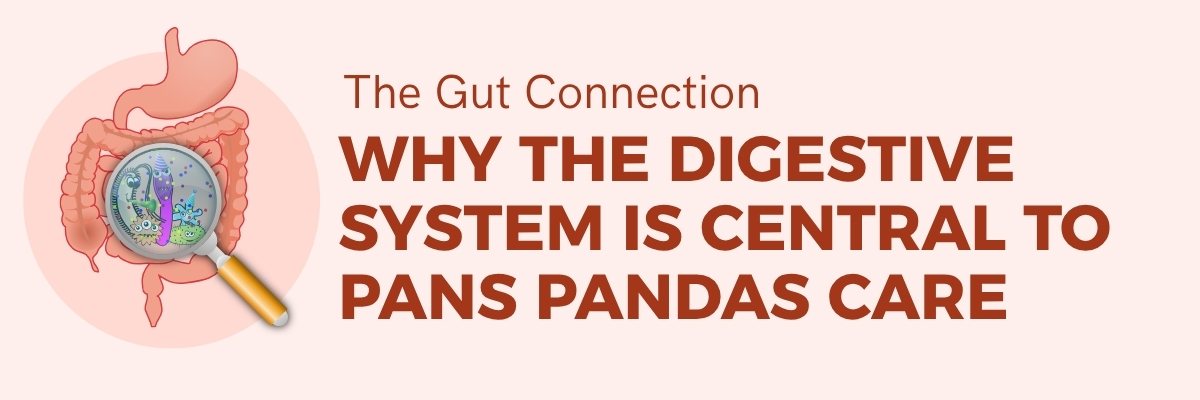
The gut, the brain, and the immune system are one interconnected system — not three separate ones that happen to coexist in the same body. When the gut is inflamed, dysregulated, or struggling under repeated infection and antibiotic treatment, those signals travel directly to a brain that is already under immunological assault. A child who cannot tell you their gut hurts will communicate it through every behavioral channel available to them. Month 6 gives parents the biological understanding to recognize those signals, the practical tools to document them in a form providers can act on, and the clinical framework to evaluate every gut support and gut testing recommendation they will encounter — so that decisions about their child's gut health are grounded in evidence rather than in the loudest marketing they happened to find first.
Goal: Parents who complete Month 6 can explain why gut health belongs in the PANS/PANDAS clinical conversation, recognize gut symptoms in a child who cannot communicate them verbally, document gut-behavior patterns in a form providers can act on, evaluate gut support and gut testing recommendations against a clear evidence-based framework, and walk into every gut-related appointment as an informed clinical partner rather than a passenger in their child's care.
📋 What This Month Is About
The gut, the brain, and the immune system are one interconnected system — not three separate ones that happen to coexist in the same body. In PANS and PANDAS, a gut that is inflamed, dysregulated, or struggling under repeated infection and antibiotic treatment sends signals directly to a brain that is already under immunological assault. Month 6 gives parents the biological understanding to recognize those signals, the practical tools to document gut-behavior patterns in a form providers can act on, and a clear framework for evaluating every gut support and gut testing recommendation they will encounter — so that decisions about their child's gut health are grounded in evidence rather than in the loudest marketing they happened to find first.
The gut is not a side issue in PANS/PANDAS — and Month 6 makes that case completely. These six lessons build the biological understanding that most families in this space never receive: why the gut, the brain, and the immune system are one interconnected system rather than three separate ones; why a child who cannot tell you their stomach hurts is communicating gut pain through every behavior available to them; why the period after an antibiotic course can be as destabilizing as the flare itself; and how to support, document, and evaluate gut health in a way that changes what happens in clinical appointments.
Every lesson in this month includes printable tools — daily behavior-gut pattern trackers, post-meal reaction logs, gut support observation records, provider appointment preparation summaries, and gut testing decision guides — designed to capture what parents observe at home and translate it into clinical information providers can use. These tools do not require medical training to complete. They require honest observation and the willingness to write it down.
This material is for educational purposes only and is not medical advice. It is not intended to diagnose, treat, cure, or prevent any condition. Always consult a licensed healthcare professional regarding medical concerns, medications, supplements, testing, or treatment decisions for your child. If these previews help you understand the biological connection between your child's gut and their neuropsychiatric symptoms, the Spectrum Care Hub Learning Community delivers full trackers and templates for implementation.
Executive Summary
Month 6 builds the gut health foundation that every PANS/PANDAS parent needs — starting with the gut-brain-immune connection that explains why a child's stomach symptoms and psychiatric symptoms rise and fall together, moving through the biology of leaky gut, microbiome disruption, and the cumulative effect of repeated antibiotic courses, and arriving at the practical skills needed to recognize gut symptoms in a child who cannot communicate them verbally, support gut health during and after a flare, and evaluate gut testing recommendations without getting lost in a marketplace that has grown significantly faster than the evidence behind it. Key statistics:
These numbers matter because they explain why gut disruption in a child with PANS/PANDAS is never a side issue — it is happening inside the same biological system that is already under assault. Every lesson includes printable tools — behavior-gut trackers, post-meal logs, gut support observation records, appointment preparation summaries, and testing decision guides — designed to give parents a clinical picture their provider cannot generate from appointment notes alone.
This is the foundational lesson of the month — the one that answers the question every parent asks when gut health first comes up: what does digestion have to do with brain symptoms?
The answer begins with two facts that most parents have never been told. First: approximately 70 to 80 percent of the body's immune cells live in and around the gut — concentrated at the intestinal lining where the outside world has the most direct contact with the body's interior. Second: the gut contains approximately 500 million nerve cells — enough to form what scientists call the enteric nervous system, sometimes called the second brain — which communicates constantly with the brain above it through a dedicated pathway called the vagus nerve. Roughly 80 to 90 percent of the signals traveling through that nerve go upward, from the gut to the brain, rather than downward. The gut is reporting to the brain constantly. When the gut is inflamed or dysregulated, those reports reflect it — and a brain already under immunological attack has to respond.
The lesson also covers the neurotransmitter connection that surprises parents the most: approximately 90 to 95 percent of the body's serotonin — the neurotransmitter at the center of anxiety and mood regulation, and the target of the most commonly prescribed psychiatric medications — is produced not in the brain but in the gut. By gut cells. Influenced directly by gut bacteria. A disrupted microbiome does not cause PANS/PANDAS. But it can meaningfully affect how severe the symptoms feel and how hard it is for the brain to recover.
What you will have after this lesson: A genuine understanding of why the gut belongs in the PANS/PANDAS conversation — not as a miracle cure, but as a real biological piece of the picture. You will also have two tools: a daily gut and behavior connection log for tracking patterns at home, and a one-page provider visit prep sheet that puts your child's gut picture in a provider's hands in a form they can actually use.
You have probably already heard the phrase "leaky gut." It travels fast in PANS/PANDAS parent communities, and it arrives attached to both genuinely useful biology and some of the most aggressive supplement marketing in this entire space. Lesson 2 gives you the honest version of both.
Leaky gut is a real biological phenomenon with a real scientific name — increased intestinal permeability — and decades of peer-reviewed research behind it. The inner lining of the intestine is held together by proteins called tight junctions — the mortar between bricks in a wall. When those junctions loosen or are damaged, the gaps between gut cells widen, and substances that should be filtered out — undigested food proteins, fragments of bacterial cell walls — slip through into the bloodstream. The immune system sees them as foreign and reacts. In a child whose immune system already has a tendency to overreact, that additional immune stimulation is not background noise. It is more fuel on a fire that is already burning too hot.
The lesson walks through what causes the gut lining to become more permeable in the PANS/PANDAS context — including antibiotic use, active infection, chronic inflammation, and physiological stress — and is clear about the two-way nature of the relationship: immune activation from PANS/PANDAS can worsen gut permeability, and gut permeability can add to the inflammatory burden that keeps the immune system activated. Understanding that this runs in both directions is what allows parents to ask smarter questions about their child's gut health as part of the larger clinical picture.
What you will have after this lesson: A clear framework for evaluating leaky gut claims — including the specific red flags that separate legitimate clinical discussion from predatory marketing. You will also have a gut symptom and flare correlation log that captures whether gut symptoms and flares are clustering together in your child's specific pattern.
Most parents know this moment. Antibiotics start. Things look a little better. And then, somewhere around week two or three — or right after the course ends — something shifts again. The OCD creeps back. Sleep falls apart. The gut, which was already a struggle, gets noticeably worse. This lesson explains what is happening in that moment in plain language — and why it is not the infection coming back.
The gut microbiome is a living ecosystem of trillions of organisms — bacteria, fungi, and other microbes — that do real and important work every day: producing protective compounds that keep the gut lining strong, training and regulating the immune system, communicating directly with the brain, and keeping less helpful organisms from taking over. Many children with PANS/PANDAS already have a fragile microbiome before any infection or antibiotic arrives — with beneficial bacterial populations that are lower than their peers, and opportunistic organisms that are higher. When infection and antibiotic treatment land on that already-stressed system, the disruption that follows is not starting from a strong foundation.
Critically, the lesson establishes that the infection disrupts the gut before the antibiotic even arrives — making the gut lining more porous, disrupting the protective mucus layer, and shifting the gut's chemical environment in ways that favor less helpful organisms. The antibiotic does not start this process. It arrives when the process is already underway — and adds a second significant stress on a system already responding to the first.
What you will have after this lesson: A clear understanding of why antibiotic courses are followed by gut disruption — and why that disruption shows up as behavioral and neuropsychiatric symptoms, not just stomach problems. You will also have tools for tracking the timing of antibiotic courses relative to gut and behavioral changes — some of the most clinically valuable documentation a PANS/PANDAS parent can bring to an appointment.
This is the lesson parents most frequently say they wished they had seen earlier. Because here is the reality for many families in this space: the child is clearly miserable, and the gut may be a significant part of why — but the child cannot tell you. They may not have the words. They may not be able to locate where the pain is. Or they may have lived with gut discomfort so long that it has become their baseline — not something they register as pain, just the way their body feels. And so the gut pain finds another channel. It announces itself as a meltdown before breakfast. As rage that seems wildly out of proportion to its trigger. As three hours of sleep instead of eight.
Lesson 4 teaches parents two foundational concepts for understanding this: interoception — the ability to sense what is happening inside your own body, which is unreliable in many children with PANS/PANDAS and sensory processing differences — and visceral hypersensitivity, which is what happens when gut inflammation lowers the pain threshold so much that normal digestive activity registers as significant discomfort. Neither of these means the child is exaggerating. Both of them explain why a child can be in real and significant gut pain without being able to communicate it in words.
The lesson provides a detailed behavior signal recognition guide — a practical translation table that maps specific behavioral patterns to the gut issues they most commonly signal — and covers the four gut presentations that hide inside behavioral symptoms most often: constipation, dysbiosis, leaky gut-related food reactions, and functional abdominal pain.
What you will have after this lesson: Three tools that together build the complete picture your provider needs. A daily behavior-gut pattern tracker that captures the connection between behavioral episodes and gut timing. A post-meal behavior and food reaction log that zooms in on the window where food-triggered reactions most often appear. And a provider appointment preparation summary that consolidates your tracking into a one-page clinical document a provider can read in under two minutes.
Month 6's fifth lesson is where the biology of the previous four lessons meets the question every parent eventually arrives at: okay, so what can I actually do about it?
The lesson is built around a framework that protects families from two equally costly mistakes — doing too much at once and measuring success by the wrong standard. The gut health supplement and diet industry is one of the most aggressively marketed spaces in all of pediatric care, and PANS/PANDAS parents are a specific target. Lesson 5 gives parents the tools to navigate that landscape without spending significant money and emotional energy on things that were never going to address what was actually happening in their child's body.
On probiotics — the lesson is clear that the word "probiotic" covers an enormous range of products with very different bacterial strains, quality standards, and levels of evidence. Not all probiotics are the same, and the goal is not to find a probiotic — it is to find the right strains, at the right dose, timed appropriately around the child's antibiotic schedule, selected by a provider who knows the child's specific gut and immune picture. On diet — the lesson introduces a one-change-at-a-time framework that generates usable clinical information rather than producing dietary disruption that exhausts the family and tells them nothing.
Critically, the lesson addresses what realistic improvement actually looks like — and why parents who are waiting for dramatic transformation often miss the real signal, which is quieter and more gradual. Fewer hard mornings. Stool consistency shifting toward normal. Two fewer behavioral episodes per week. These are real, meaningful wins. Recognizing them requires knowing what to look for before you start.
What you will have after this lesson: A gut support observation log that captures your child's baseline before any new probiotic or dietary change begins — and tracks what changes, week by week, for four weeks after. And a dietary change observation record for parents who are considering or have just started a specific dietary change — built around the one-change-at-a-time framework so the results are actually evaluable.
The final lesson of Month 6 addresses one of the most common questions in the PANS/PANDAS parent community — and one of the most confusing to navigate. Gut testing sits at the intersection of genuinely useful clinical information and a marketplace that has grown significantly faster than the evidence behind it. Lesson 6 gives parents the framework to tell the difference.
The lesson covers the four main types of gut testing: comprehensive stool analysis, which looks at what organisms are living in the gut and whether anything is out of balance; organic acid testing, which measures what the gut is producing rather than what is living in it; IgG food sensitivity panels, which measure the immune system's response to specific foods — the most clinically contested of the four, with active disagreement among specialists about what the results actually mean; and intestinal permeability testing, which attempts to measure directly whether the gut lining is doing its job.
Throughout, the lesson keeps one question at the center: will the result of this test actually change what we do? If a positive result would lead to a specific, targeted intervention that would not otherwise be pursued — and if a negative result would also tell you something useful — the test is earning its place. If the answer to both parts of that question is unclear, the test is not ready to be ordered. The lesson is also specific about the red flags that signal predatory testing practice: large panels ordered without a clear rationale, a supplement recommended for every flagged value, consumer microbiome kits presented as equivalent to clinical tests, and testing recommended before foundational gut support has even been tried.
What you will have after this lesson: Two tools that support the full arc of the testing conversation. A simple decision guide — eight plain-language questions to work through before agreeing to any gut test — that takes five minutes and ensures you understand what you are agreeing to and why. And a results appointment guide — a structured framework to work through with your provider during the results review — so you leave every results appointment knowing what needs to happen next, what to watch for at home, and when to follow up.

What a child with PANS/PANDAS eats every day is not a minor consideration — it is a daily biological input that either adds to or reduces the inflammatory burden their immune system is already managing through three specific pathways: gut barrier function, microbiome composition, and inflammatory signaling. Month 7 gives parents the honest, evidence-grounded framework to understand that relationship, identify the nutrient deficiencies most commonly found in this population and how to get them properly tested, evaluate any dietary claim before acting on it, and make sustainable improvements in a household where food rigidity, mealtime battles, sibling dynamics, and real financial constraints are already part of daily life.
Goal: Parents who complete Month 7 can explain how food affects inflammatory burden through specific biological pathways, evaluate dietary claims against an honest evidence standard before acting on them, identify their child's specific nutrient deficiency risk factors and request the appropriate targeted testing in partnership with their provider, apply the test-address-observe-decide framework to nutrient correction, and implement one sustainable dietary change at a time using the environment strategy — in a way that protects the whole family including siblings rather than creating new sources of daily stress.
📋 What This Month Is About
Nutrition and food sensitivities in PANS/PANDAS refer to the documented relationship between what a child eats every day and the inflammatory burden their immune system is carrying — including how specific foods drive or reduce inflammation, how common nutrient deficiencies develop in this population and silently undermine treatment, and how dietary changes can be made sustainably in a household where food rigidity, mealtime battles, and financial constraints are already part of daily life. Food does not cause PANS/PANDAS and it does not cure it — but what a child eats every single day either adds to or reduces the biological burden an already-overloaded system is managing. Month 7 gives parents the honest, evidence-grounded framework to understand that relationship and act on it in a way that is realistic for their real family.
Most parents of children with PANS/PANDAS are already paying attention to food. Not because anyone told them to — but because they are paying attention to everything. Every pattern, every possible connection, every lever they might be able to pull. And in every parent community, the dietary advice comes fast and with complete certainty: cut gluten, eliminate dairy, remove all food dye, clean up the diet and everything will settle down. It is said by people who genuinely believe it and who are genuinely trying to help. And it is said so often that it starts to feel like established fact.
Some of it is. Some of it is not. And the parts that are true are true in ways that are more specific, more conditional, and more dependent on an individual child's biology than the certainty in those conversations suggests. A parent who acts on every dietary claim they encounter without a framework for evaluating it is spending money their family may not have, creating mealtime battles their child's nervous system cannot afford, and possibly addressing the wrong variable entirely while the right one goes unaddressed.
Month 7 is the honest version of the dietary conversation. Five lessons that cover what the research actually shows — not the version circulating in parent groups, and not the dismissive version that comes from providers who have never looked at the evidence — but the actual picture, with all of its complexity and all of its uncertainty delivered in a way that helps parents make real decisions for their real child. Parents who complete this month understand which dietary factors have meaningful evidence behind them and which are driven by trend rather than science, how to evaluate any dietary claim before acting on it, which nutrient deficiencies are silently making everything harder and how to get them properly tested, and how to make sustainable dietary improvements in a household where a child with PANS/PANDAS is already making mealtimes one of the hardest parts of the day.
Every lesson in this month includes printable tools — food and symptom observation logs, dietary audit forms, food dye sensitivity assessment guides, claim evaluation frameworks, nutrient deficiency risk profiles, testing appointment preparation documents, and one-change implementation plans — designed to turn daily observation into clinical information providers can actually use.
This material is for educational purposes only and is not medical advice. It is not intended to diagnose, treat, cure, or prevent any condition. Always consult a licensed healthcare professional regarding medical concerns, medications, supplements, testing, or treatment decisions for your child. If these previews help you build a clearer picture of how food affects your child's biology, the Spectrum Care Hub Learning Community delivers the full curriculum with complete tools and templates for implementation.
Executive Summary
Month 7 builds the nutritional foundation that most PANS/PANDAS families never receive — starting with an honest examination of how food affects inflammatory burden through three specific biological pathways, moving through the evidence on gluten, casein, sugar, food dyes, and ultra-processed food with clear distinctions between what is well-supported and what has run ahead of the science, and arriving at the practical skills needed to identify and address the nutrient deficiencies most commonly found in this population and to make dietary changes that a real household with a restricted eater can actually sustain. Lessons cover the inflammatory burden framework — the concept that what a child eats every day either adds to or reduces the total biological burden their immune system is managing — and why this matters more for children with PANS/PANDAS than for typically developing children; why gluten and casein elimination works for a meaningful subset of children and how to evaluate whether your child might be in that subset; why refined sugar has the strongest and most consistent evidence of any dietary factor in this space and how to identify where it lives in your child's daily pattern; why food dye sensitivity is real but specific — most relevant for children with histamine sensitivity, mast cell involvement, or ADHD alongside their PANS/PANDAS diagnosis — and how to assess whether it is relevant for your child before acting; which nutrients are most commonly depleted in this population and why standard pediatric bloodwork misses most of them; and how to make dietary improvements in a household where food rigidity, sensory issues, mealtime battles, sibling dynamics, and real financial constraints are already part of daily life. Every lesson includes printable tools — observation logs, audit forms, sensitivity assessment guides, claim evaluation frameworks, nutrient risk profiles, testing prep documents, and change implementation plans — designed to help families turn daily observation into clinical information their provider can act on.
What it covers:
Why it matters:
Every parent of a child with PANS/PANDAS encounters the dietary conversation — in parent groups, from practitioners, in their own late-night reading. Most of what they find is either dramatically overstated or reflexively dismissed. Neither version serves them. A parent who understands the actual biology of how food affects their child's inflammatory burden — not as a cure, not as irrelevant, but as a real daily input that can be managed thoughtfully — makes better decisions with their provider, wastes less money on interventions that are not matched to their child's biology, and approaches the subject with the honest expectations that produce real, sustainable change. This lesson builds that foundation before a single dietary recommendation is made.
What it covers:
Why it matters:
Gluten and casein elimination is one of the most discussed dietary interventions in PANS/PANDAS communities — and one of the most misunderstood. Parents either pursue it impulsively based on another family's dramatic result, attempt it without structure and conclude it does not work after two uncontrolled weeks, or dismiss it entirely because a provider told them it was unnecessary without assessing their individual child's picture. None of those outcomes serves the child. This lesson gives parents the honest, specific information needed to evaluate whether a structured trial makes sense for their child's biology — and if it does, to run that trial in a way that produces real clinical information rather than just effort.
What it covers:
Why it matters:
Sugar, food dyes, and processed food are the subjects of more confident, unqualified dietary claims in PANS/PANDAS parent spaces than almost anything else in this curriculum. A parent who cannot distinguish between a claim with genuine evidence behind it and one driven by wellness culture trend is vulnerable to spending money, creating mealtime battles, and directing effort toward the wrong variable. This lesson gives parents three specific tools — a sugar audit, a food dye sensitivity assessment, and a claim evaluation framework — that together replace reactive decision-making with structured, evidence-grounded evaluation. The result is not a dietary protocol. It is the ability to think clearly about any dietary claim they will ever encounter.
What it covers:
Why it matters:
Nutrient deficiency is one of the most consistently overlooked layers in PANS/PANDAS care. A child who is significantly low in vitamin D has an immune system working with depleted regulatory resources. A child who is low in magnesium has a nervous system that is harder to bring back to baseline. A child whose B12 is low has methylation pathways that cannot do their job efficiently — and methylation touches immune function, inflammation, and neurotransmitter production in ways that ripple through the entire clinical picture. Correcting a documented deficiency does not cure PANS/PANDAS. But it removes a biological obstacle that has been quietly making everything harder — and that matters enormously for a child whose system is already under significant strain. This lesson also addresses the financial reality directly: comprehensive nutrient testing has a real cost, and the test-address-observe-decide framework is designed to produce the most clinically useful information at the most financially realistic pace.
What it covers:
Why it matters:
A parent who finishes the first four lessons of this month with a clear understanding of what should change in their child's diet — and then goes home to a child who eats twelve foods and melts down when the wrong brand of crackers appears — needs something different from more information. They need a framework for making change in the real conditions of their real household, with their real child, within their real financial constraints, without adding more daily stress to a family that is already running on empty. This lesson is that framework. It is also honest about when mealtime difficulty has reached a level that requires professional support — a feeding therapist and registered dietitian — rather than a different strategy. The clinical red flags that signal that threshold are named directly, along with the specific scripts for requesting those referrals.
The sleep destruction, the anxiety that cannot be reasoned away, the rage and shutdown that arrive without warning — these are neurological events driven by active brain inflammation, and they respond to approaches that are matched to that biology in ways they simply cannot respond to approaches designed for something else. Month 8 gives families the biological framework that makes that distinction clear, the clinical vocabulary to bring it to a provider conversation that produces a genuine response, and the practical tools to act on it every day of a flare — including a step-by-step framework for the hardest nights, episode documentation records that replace terrifying memories with organized clinical information, and a daily regulation plan built before the crisis rather than improvised during it.
Goal: Families who complete Month 8 can explain the neurological basis of their child's sleep disruption, anxiety, and dysregulation episodes in plain language that produces a clinical response rather than a dismissal, document what is happening at home in the specific, organized way that gives a provider what they need to make the best possible decisions, identify which commonly used approaches are contraindicated for this population and stop spending energy on them, and use the regulation tools available at home — including their own nervous system — more deliberately and more consistently than they could before this month.
📋 What This Month Is About
Sleep destruction, neurologically driven anxiety, and the rage and shutdown episodes of PANS/PANDAS are not behavioral problems and they are not failures of parenting. They are neurological events driven by active brain inflammation, and they respond to approaches that are matched to that biology in ways they simply cannot respond to approaches designed for something else. Month 8 gives families the biological framework that makes that distinction clear — and the practical tools to act on it every day of a flare.
Most parents of children with PANS/PANDAS know what sleep destruction looks like from the inside. Not the version described in a clinical summary — the version that happens at 2am when the child cannot fall asleep because the worry thoughts will not stop, or at 4am when the night terror ends and neither child nor parent can find their way back to sleep, or at 5am when the early waking begins and the whole household is already up before the day has properly started. They know what it looks like when a child is consumed by fear that calm explanation cannot reach. And they know what it looks like when the child they love disappears into a rage or a shutdown — and then surfaces afterward confused and frightened and unable to explain what just happened to them.
These are not behavioral mysteries. They are neurological events driven by the same inflammatory process driving every other symptom of this condition. The brain structures that regulate sleep, manage the fear response, and keep the emergency system from running at full power all day are the same structures that PANS/PANDAS inflammation disrupts. Understanding this does not make the hard nights shorter or the hard moments less frightening. But it changes what parents reach for when those moments come — and it changes what they say in the appointment that follows, what they bring to that appointment, and what they ask for. Month 8 is built around that understanding: the biological framework for what is actually happening during a flare, delivered in plain language, paired with the practical tools that translate that understanding into something a family can use today. Every lesson includes printable tools — sleep observation records, episode documentation forms, provider preparation documents, regulation profiles, and daily planning frameworks — designed to turn daily observation into clinical information a provider can act on.
This material is for educational purposes only and is not medical advice. It is not intended to diagnose, treat, cure, or prevent any condition. Always consult a licensed healthcare professional regarding medical concerns, medications, supplements, testing, or treatment decisions for your child. If these previews help you understand the biology behind what you have been watching — and give you the language to bring it to a provider who can act on it — the Spectrum Care Hub Learning Community delivers the complete lesson library, printable tools, and ongoing support for the full journey.
Executive Summary
Month 8 moves through five lessons that together connect the biology of sleep destruction, anxiety, rage, and shutdown to the practical daily tools families can use during a flare. The month opens with the biological foundation for why sleep falls apart — the simultaneous disruption of the sleep-signal hormone, the alertness hormone that should drop at night, and the nervous system's ability to shift from alert to rest mode — and what that disruption means for the brain's overnight cleaning process and the inflammatory cycle that disrupted sleep sustains. The second lesson moves from the why to the what to do, with a clinically grounded sequential framework for the hardest nights, two concrete tools that replace midnight improvisation with pre-made decisions, and explicit guidance on which commonly attempted approaches are actively contraindicated in a child with active neuroinflammation. The third lesson names what most resources cannot explain clearly: why the anxiety in PANS/PANDAS does not respond to logic, reassurance, or standard anxiety treatment, because it is generated by inflammation affecting specific brain structures that operate below the level where reasoning functions — and what that means for which therapeutic approaches are appropriate, when, and in what order. The fourth lesson addresses the episodes that most break a parent's heart: the rage that arrives without warning, the shutdown where the child becomes neurologically unreachable, and the frightening statements a child may make during an episode they will not remember afterward — each one explained through the specific neurological mechanism producing it, with guidance on what to do during the episode, what to document before the appointment, and how to bring the safety picture to a provider in the organized, specific way that produces a clinical response. The fifth lesson brings everything forward into the practical daily tools available at home — the window of tolerance framework that explains why what looks like an extreme reaction to a small trigger is a full emergency response from a nervous system that was already close to its limit, and the specific regulation tools that have biological rationale for this population, from co-regulation and sensory environment management to predictable routine and the parent's own nervous system as the single most powerful regulation resource in the home. Every lesson includes printable tools — sleep observation logs, episode documentation records, provider preparation documents, regulation profiles, and daily planning frameworks — designed to help families document what is happening and walk into every appointment with organized information a clinician can act on.
What it covers:
Why it matters:
Most families spend months managing sleep disruption as though it were a behavioral or routine problem — trying strategies designed for typically developing children, following advice that was not written for this condition, and concluding that nothing works. This lesson reframes the problem from the ground up. Sleep disruption in PANS/PANDAS is a neurological symptom of the inflammatory process — not a habit to manage or a bedtime routine to enforce. Understanding this distinction protects families from wasting months on the wrong approaches, and gives parents the biological vocabulary to bring the sleep conversation to a provider in a way that produces a clinical response rather than a referral to a sleep specialist who has never heard of this condition.
What it covers:
Why it matters:
Families in the middle of a flare are being pulled in multiple directions by advice that was not designed for this condition — standard sleep hygiene recommendations, approaches that work for typically developing children, suggestions from other parents whose children may have completely different biological presentations. This lesson cuts through that noise with a clinically grounded framework specific to PANS/PANDAS, two concrete tools that replace improvisation with pre-made decisions, and clear explanation of why some commonly used approaches — including extinction-based sleep training and abrupt withdrawal of reassurance without therapeutic support — are actively contraindicated in a child with active neuroinflammation and add to the inflammatory burden rather than reducing it.
What it covers:
Why it matters:
The single most demoralizing experience parents describe in this condition is trying to reason with fear that cannot hear reasoning — calm explanations that produce no change, patient reassurance that makes the cycle worse, therapeutic interventions that would help a different kind of anxiety but cannot reach this one. This lesson names why. Understanding that the anxiety is coming from a brain structure running its alarm system below the level where reasoning operates changes what parents reach for, what they stop trying, and what they say in the appointments where the treatment decisions are made. It also gives parents explicit permission to stop carrying guilt for their response to their child's genuine neurological distress.
What it covers:
Why it matters:
Rage and shutdown are the symptoms that most damage families who do not have a framework for them. Without that framework, parents pursue behavioral consequence systems that cannot reach a brain where the reasoning department is offline, schools apply physical restraint that confirms the emergency and escalates rather than de-escalates the episode, and everyone in the household carries guilt and confusion about events that had a biological cause and a biological explanation. This lesson gives families the framework that changes how they respond in the moment, what they document before the next appointment, and what they say to the providers and school staff who are trying to help without understanding what they are looking at.
What it covers:
Why it matters:
This lesson is the practical payoff for everything this month has built. Four lessons of biological understanding arrive here as a set of tools that can be used today — before the next appointment, before the flare resolves, in the ordinary moments of a hard day. No expensive equipment, no special training, no protocol that requires a regulated child to comply with it to work. A completed regulation profile captures what a parent already knows about their specific child and turns it into a reference that replaces guesswork with pre-made knowledge. A daily regulation plan maps the highest-risk moments of the day and provides responses that were built before the crisis rather than improvised during it. The parent who finishes this lesson has something concrete they can do right now. That is the whole point of this month.

The therapy sessions and school days that are supposed to support your child's development can become sources of additional neurological stress during a flare — not because providers and teachers are failing, but because nobody has given them the information they need to respond to a child whose brain is under active inflammatory assault. Month 9 gives families the framework, the tools, and the legal knowledge to change that across every setting where their child spends time — from the OT clinic to the IEP meeting to the classroom where a substitute teacher has never heard the words PANS or PANDAS.
Goal: Families who complete Month 9 can explain the two-phase therapy model to every provider on their child's team and establish a written flare protocol before the next crisis arrives, use the Cross-Provider Therapy Tracker to give every therapist a current picture of what is happening across the full therapy landscape, walk into any IEP or 504 meeting knowing exactly what they have the right to ask for and the language that turns requests into school obligations, hand a teacher or aide the plain-language tools that make an appropriate flare response possible in real time, and pursue formal educational alternatives — including homebound instruction — with the knowledge of what the law provides and what federal employment protections may make it possible.
📋 What This Month Is About
During a PANS/PANDAS flare, the therapy sessions and school days that are supposed to support your child's development can become sources of additional neurological stress — not because the providers and teachers are failing, but because nobody has given them the information they need to respond to a child whose brain is under active inflammatory assault. Month 9 gives families the framework to change that: what therapy and school should look like during a flare versus remission, how to communicate your child's medical reality to every provider and educator who works with them, and what legal rights and formal accommodations exist to protect your child's education when the standard approach is not enough.
Most parents navigating PANS/PANDAS have sat in a therapy waiting room during a flare and wondered whether any of it is helping. They have watched a child fall apart in a session that was supposed to build skills — and felt the particular exhaustion of knowing that tomorrow there will be another session, another drive, another explanation to a provider who does not fully understand why the child who made real progress three weeks ago cannot get through thirty minutes today. They have received notes from teachers about behavior that they recognize immediately as flare symptoms — and felt the isolation of knowing that the person writing those notes has never heard of the condition producing them. They have sat in IEP meetings not knowing what they had the right to ask for, or stayed home from work during a severe flare without knowing that federal law may have protected their job while they did it.
Month 9 addresses all of it — not as separate problems but as connected pieces of the same challenge: how to keep your child's development moving, their educational rights protected, and their therapy relationships intact when the brain is under attack. Every lesson includes printable tools — therapy observation logs, cross-provider trackers, therapist briefing documents, accommodation request guides, school reference sheets, flare notification templates, and home management planning frameworks — designed to turn what you are already observing into organized, usable information that every provider on your child's team can act on.
This material is for educational purposes only and is not medical advice. It is not intended to diagnose, treat, cure, or prevent any condition. Always consult a licensed healthcare professional regarding medical concerns, medications, supplements, testing, or treatment decisions for your child. If these previews help you understand what your child needs from their therapy and school team during a flare — and give you the tools to make that happen — the Spectrum Care Hub Learning Community delivers the complete lesson library, printable tools, and ongoing support for the full journey.
Executive Summary
Month 9 moves through six lessons that together build a complete framework for protecting your child's therapy trajectory and educational rights across every phase of the condition. The month opens by establishing the foundational clinical distinction that everything else depends on — that a child in a flare and a child in remission are not in the same neurological situation, and that therapy goals must match the phase the brain is actually in rather than the phase everyone hopes it is in. The second lesson moves from framework to conversation, giving parents the specific tools and scripts to bring the medical picture to every therapist who works with their child and to establish a written flare protocol before the next crisis arrives. The third lesson goes inside each therapy type specifically — occupational therapy, speech-language therapy, and cognitive behavioral therapy — so that every conversation with every provider is precise and clinically grounded rather than general. The fourth lesson shifts to school, giving parents a plain-language guide to the IEP and 504 plan process, a pre-filled accommodation checklist built around the specific needs of PANS/PANDAS children, and the legal framework that turns accommodation requests into school obligations. The fifth lesson addresses the human side of school communication — how to reach the teachers, aides, and specialists who are with your child every day but have never heard of the condition, with tools designed to be handed directly to school staff rather than filed in an office. The sixth and final lesson covers the options most parents do not know exist until they desperately need them — homebound instruction, reduced school days, and the federal employment protections that may make staying home with a severely ill child possible without losing a job. Every lesson includes printable tools designed to help families document what is happening, communicate it clearly, and walk into every appointment and meeting with organized information that the people across the table can act on immediately.
What it covers:
Why it matters:
Most families spend months of therapy sessions during flares watching their child fall apart — assuming the therapy is failing, the child is regressing, or something about the approach needs to be intensified. This lesson reframes the entire picture. The therapy is not failing. The goals are wrong for the phase. Understanding this distinction protects months of therapeutic relationship-building from being damaged by sessions that were measuring a flare against a remission standard — and gives parents the framework they need to bring a genuinely useful clinical conversation to every provider on their child's team.
What it covers:
Why it matters:
A therapist who has read the briefing document, had a five-minute conversation about what a flare looks like for your specific child, and has a written protocol in place is a fundamentally different clinical resource than one who is interpreting your child's flare-phase participation through a behavioral lens with no medical context. This lesson gives parents exactly what they need to produce that difference — before the next flare, not in the middle of one.
What it covers:
Why it matters:
Your child's OT, speech therapist, and CBT provider are almost certainly not communicating with each other. You are the only person in your child's care who sees all of it. This lesson gives that knowledge a structure — a single living document that travels with the child across the entire therapy team and gives every provider a current, cross-team picture in sixty seconds. It also gives parents the therapy-specific clinical knowledge that makes every provider conversation sharper, more precise, and more likely to produce the right clinical response for the specific therapy type in front of them.
What it covers:
Why it matters:
Most PANS/PANDAS parents walk into IEP and 504 meetings without knowing what they have the right to ask for — and leave with a plan that is incomplete because the school offered what they thought was appropriate rather than what the child's medical situation actually requires. This lesson closes that gap entirely. The accommodation checklist means a parent never leaves a meeting without having asked for everything their child clinically needs. The flare protocol language means the next flare arrives with an agreement already in place rather than a new negotiation in the middle of a crisis.
What it covers:
Why it matters:
The formal IEP or 504 plan lives in the special education coordinator's office. The teacher covering the class on a flare day may have never read it. This lesson addresses the human communication that makes the formal plan actually work in practice — giving the adults who are physically with your child every day the specific, plain-language information they need to respond appropriately in the moments that matter, without requiring them to find and read a formal document in the middle of a crisis.
What it covers:
Why it matters:
Most parents discover homebound instruction by accident, in the middle of a crisis, after weeks of pushing a child through an environment that was making everything harder. This lesson puts that knowledge in front of families before the crisis — or in the middle of one — so that the decision about whether to pursue formal educational alternatives is genuinely informed rather than made without knowing what was available. It also addresses, directly and compassionately, the families for whom homebound instruction feels financially impossible — and gives them the specific federal and state protections that may make it possible, or the specific school accommodations that reduce harm when it is not.

PANS/PANDAS care requires a team — not because the medical system is fragmented, though it often is, but because this condition genuinely lives at the intersection of four specialties and cannot be comprehensively treated by any one of them alone. Month 10 gives families everything they need to build that team deliberately: the map of who each specialist is and what they do, the search tools that surface real expertise in a landscape not organized around this condition, the evaluation framework that identifies the right clinical framework before a family commits to a protocol, the filter that protects against the predatory practice concentrated in this space, the coordination infrastructure that turns a collection of specialists into a functioning team, and the clinical conversation that opens the door to the biomedical framework — addressing the immune piece that conventional care has never reached — that changes everything that comes after.
Goal: Families who complete Month 10 can name every specialist on a PANS/PANDAS team and explain what each one specifically contributes, use the MAPS directory and parent community resources to search for knowledgeable providers with the specificity and filters that produce real results, walk into any first provider appointment equipped to evaluate the clinical framework in the room before committing to the protocol behind it, apply the treatment evaluation checklist to any new recommendation from any source before acting on it, maintain a Master Clinical Summary that gives every provider the complete current clinical picture before every appointment, and walk into the biomedical integration conversation with a documented pattern, a plain-language question, and a specific next step written down before leaving the parking lot.
📋 What This Month Is About
Most families navigating PANS/PANDAS reach a point where they understand, at least in general terms, that their child needs more than one provider — and still have no idea how to find them, how to evaluate them, how to get them working together, or how to protect their child from the practitioners in this space who are not offering what they claim to offer. Month 10 closes every one of those gaps. From the map of who each specialist is and what they do, to the specific directories and search strategies that surface real expertise, to the tools for evaluating a provider before committing to their protocol, to the infrastructure that keeps a multi-provider team working coherently, to the filter that identifies predatory practice before it costs a family time and money they cannot recover — and finally to the most important clinical conversation most families have not yet had: why conventional care alone is not enough, and what biomedical integration adds that makes everything else work the way it was supposed to.
The families who get the most out of Month 10 are not the ones who already have a complete team in place. They are the ones who have been navigating this condition without a roadmap — seeing providers who were doing their best but not enough, spending money on treatments without a way to evaluate whether those treatments were working, and carrying the full clinical picture of their child in their own head because nobody else was holding it together. This month gives every one of those families the tools they have been missing — organized, plain-language, and built for use in real appointments with real providers rather than filed away in a binder nobody opens.
This material is for educational purposes only and is not medical advice. It is not intended to diagnose, treat, cure, or prevent any condition. Always consult a licensed healthcare professional regarding medical concerns, medications, supplements, testing, or treatment decisions for your child. If these previews help you understand what your child needs from their medical team — and give you the tools to find it, evaluate it, and protect it — the Spectrum Care Hub Learning Community delivers the complete lesson library, printable tools, and ongoing support for the full journey.
Executive Summary
Month 10 moves through six lessons that together build a complete framework for finding, evaluating, coordinating, and protecting the medical team that PANS/PANDAS care genuinely requires. The month opens by establishing the foundational map that most families never received — who each specialist is, what they specifically do in PANS/PANDAS care, and how a list of providers becomes an actual functioning team rather than a collection of isolated experts each seeing only their own piece of the picture. The second lesson moves from the map to the search — the specific directories, search strategies, pre-call screening tools, and parent community resources that turn an overwhelming provider search into a series of concrete, productive steps. The third lesson addresses the moment most families have been preparing for and dreading simultaneously: the first appointment with a new provider, and how to evaluate in real time whether the provider across the room has the clinical framework their child actually requires. The fourth lesson provides the filter that every PANS/PANDAS family needs — a structured, plain-language tool for evaluating any new treatment recommendation before acting on it, and an accountability record that holds a treatment to what it promised once the decision to proceed has been made. The fifth lesson builds the coordination infrastructure that converts multiple specialists into a coherent team — a master clinical summary every provider reads before every appointment, and a communication log that makes provider disagreements visible before they affect clinical decisions. The sixth and final lesson addresses the most important clinical conversation in this curriculum: why conventional care alone cannot fully treat this condition, what biomedical integration adds, and how to walk into the appointment where that conversation happens prepared, confident, and equipped with the specific documented evidence that moves a provider from theoretical openness to a concrete clinical next step.
What it covers:
Why it matters:
Most families spend months navigating a condition that requires a team without ever having been given a clear picture of what that team looks like, who each member is, and what they are specifically for. A parent who walks into a specialist appointment knowing that provider's precise role in PANS/PANDAS care asks better questions, gets more useful answers, and leaves with a clearer plan than a parent who is still trying to understand what kind of doctor they are seeing while the appointment is happening. This lesson closes that gap entirely — and gives families the framework they need to evaluate every provider relationship they already have and every one they are about to build.
What it covers:
Why it matters:
The families who find the right providers are not the ones with the most resources or the most luck. They are the ones who knew what to search for, where to look, and how to evaluate what they found. This lesson gives every family those three things — along with the two-minute pre-call screening tool that prevents wasted appointments, and the provider search tracking sheet that converts a scattered multi-directory search into one organized document that builds on itself rather than starting over every time.
What it covers:
Why it matters:
After months of searching and waiting, a parent walking into a first provider appointment is often so relieved to have finally arrived that they mistake warmth for competence and availability for expertise. This lesson reframes that appointment entirely. Evaluating a provider is not hostile — it is the most loving thing a parent can do with the access they have fought their way into. The tools in this lesson mean that every first appointment produces a clear, specific, written assessment rather than a general impression that blurs within hours — and that the follow-through after the appointment is driven by a record rather than a feeling.
What it covers:
Why it matters:
Predatory practice in the PANS/PANDAS space does not announce itself. It presents as enthusiasm, certainty, and the promise of help that the mainstream system refused to offer. The families most at risk are not the least educated or the least careful — they are the most desperate, the most loving, and the most willing to try one more thing for a child who is suffering. This lesson gives those families a filter — applied before action, not after regret — that costs five minutes and has saved families from decisions that cost them years.
What it covers:
Why it matters:
You are the only person in your child's care who talks to everyone. That is not a coincidence — it is the structural reality of a condition that lives between specialties in a system not built for it. The question is not whether you will be the coordinator. You already are. The question is whether you will do it reactively, exhausted, carrying the full clinical picture in your head — or deliberately, equipped, with a document that does the work of establishing the clinical picture so every appointment can spend its time on clinical reasoning rather than administrative reconstruction.
What it covers:
Why it matters:
This is the lesson that opens the door everything in this curriculum has been building toward. The months ahead — the immune modulation conversations, the gut and nutritional support, the full biomedical framework that produces the sustained progress conventional care alone has not been able to produce — all of them depend on a family having had this conversation with their provider and arrived at a specific clinical next step. This lesson ensures that conversation happens with documentation behind it, language the parent is confident using, and a clear record of what was decided so the follow-through is driven by a specific dated plan rather than a hope that something changes.

The parents who change what happens in their child's appointments are not always the ones with the most medical knowledge or the most access to specialists. They are the ones who have organized what they already know into a form the medical system can act on. Month 11 builds that form — completely, sustainably, and in plain language that any provider can read and act on in under two minutes. The Flare History Record. The In-Flare Observation Log. The Flare Severity Snapshot. The Flare Close-Out Summary. The Trigger-to-Onset Gap Record. The Symptom Fingerprint Tracker. The Flare Onset Card. The Complete Flare Documentation Checklist. The Early Warning Profile and Action Plan. The New Provider Briefing Document. The Medication and Treatment History. Each one solves a specific problem. Together they build the clinical record that means a child is never starting over — because the full story of their condition arrives before every conversation, in every new clinical relationship, for the rest of their care.
Goal: Families who complete Month 11 can maintain a complete, organized documentation system across every phase of every flare — onset, course, peak, and exit — and keep it current with a post-flare update session of thirty to forty minutes. They can present the trigger-to-onset pattern across all documented episodes in a form any provider can read in thirty seconds and cannot attribute to coincidence. They can identify their child's individual early warning signals from their own documented record and activate a pre-decided action plan within hours of the first signal appearing. They can walk into any first appointment with any new provider — specialist, primary care, urgent care, or emergency — with a complete clinical record organized in a master folder, a two-page briefing document that tells the full story, and a medication and treatment history that gives any prescribing provider accurate, complete information before a single decision is made.
📋 What This Month Is About
Most families navigating PANS and PANDAS are carrying an enormous amount of clinical knowledge — in their heads, in scattered notes, in the memory of every flare they have lived through and every treatment course they have managed. They know their child's pattern better than anyone. They know which antibiotic has worked best, how long it takes to see improvement, which symptoms appear first and which ones linger longest. They have been watching carefully and they have been right about things that took providers months to catch up to. The problem is not what they know. The problem is that what they know is not organized in a form the medical system can act on — and every time a new provider walks into the room, the family starts over.
Month 11 ends that. Across six lessons, this month builds the complete documentation system that transforms everything a parent already knows into a clinical record that changes what happens in every appointment from here forward. The Flare History Record that shows the full arc of the condition across every episode. The In-Flare Observation Log that captures the day-by-day shape of an active flare in real time. The Trigger-to-Onset Gap Record that makes the timing pattern between illness and neuropsychiatric symptom onset visible in a column of numbers any provider can read in thirty seconds. The Symptom Fingerprint Tracker that shows exactly which symptoms are core to every flare and which ones are new — and what a widening symptom picture means clinically. The Early Warning Profile and Action Plan that move the decision-making about what to do at the first sign of a flare out of the stress moment and into a calm one. And finally the New Provider Briefing Document and the Medication and Treatment History — the two documents that mean a child is never starting over with a new provider, because the full clinical story arrives before the conversation begins.
The families who get the most out of Month 11 are not the ones who already have perfect records. They are the ones who have been carrying their child's clinical history in their head for months or years, who have sat in appointments trying to compress years of careful observation into fifteen minutes, and who have left those appointments feeling that the provider made decisions without the full picture. This month gives every one of those families the system they needed from the beginning — organized, sustainable, and built for use in real appointments with real providers.
This material is for educational purposes only and is not medical advice. It is not intended to diagnose, treat, cure, or prevent any condition. Always consult a licensed healthcare professional regarding medical concerns, medications, supplements, testing, or treatment decisions for your child. If these previews help you understand how to document your child's condition and advocate for them more effectively — and give you the tools to walk into every appointment as a clinical partner — the Spectrum Care Hub Learning Community delivers the complete lesson library, printable tools, and ongoing support for the full journey.
Executive Summary
Month 11 moves through six lessons that together build a complete, integrated documentation system for families navigating PANS and PANDAS. The month opens by establishing why documentation is not an administrative task but a clinical tool — one that changes what providers can see, what they can justify, and what they can do for a child whose condition is episodic, pattern-dependent, and frequently underestimated by the chart alone. The second lesson goes inside an active flare and teaches parents to capture the specific observations that carry the most clinical weight — at the onset, the peak, and the exit — in three simple tools that take minutes to complete and produce a record that cannot be reconstructed from memory. The third lesson takes the raw documentation from individual flares and transforms it into the two cross-episode tools that make the biological argument no verbal account can make — a trigger-to-onset gap record that shows the timing pattern in a column of consistent numbers, and a symptom fingerprint tracker that shows which symptoms are core, which are new, and what a changing picture means. The fourth lesson assembles all of these tools into one integrated system with a master folder architecture, a one-page onset capture card that anchors every episode, and a complete documentation checklist that ensures nothing is missed at any phase of the flare cycle. The fifth lesson turns the accumulated documentation into an early warning system — teaching parents to extract their child's specific pre-flare signals from the existing record, build a personalized early warning profile, and pair it with a pre-decided action plan that activates the moment a signal appears. The sixth and final lesson builds the two documents that make all of this work in every new clinical relationship: a structured New Provider Briefing Document that tells the story the chart does not tell, and a complete Medication and Treatment History that gives any prescribing provider the full picture before a single decision is made.
What it covers:
Why it matters:
A provider who receives a clear written flare history before an appointment begins spends that appointment on clinical decision-making rather than fact-finding. A provider who sees a consistent pattern documented across multiple episodes — rather than hearing it described verbally under time pressure — is a provider who can justify escalation, referral, and treatment changes that a verbal account alone cannot support. The documentation system starts here, with the foundational record that every other tool in this month feeds into and builds on. A parent who completes the Flare History Record this week and brings it to the next appointment will feel the difference immediately.
What it covers:
Why it matters:
The Flare Close-Out Summary is where treatment adequacy lives. Whether the antibiotic course was long enough. Whether the recovery was full or partial. Whether any symptoms persisted after the flare resolved that were not there before. That information lives nowhere else — not in the chart, not in the appointment notes, not in any document a provider generates. It lives in the parent's careful observation of what happened during and after the episode. This lesson teaches parents to capture that observation in real time, in the moments when the details are still sharp, in a form that a provider can act on at the next appointment.
What it covers:
Why it matters:
A parent who says in an appointment, "Every time he gets sick, the behavioral symptoms start about a week later," is describing a pattern. A parent who hands a provider a document showing that the gap has been seven to eleven days across ten documented episodes — including four where the rapid strep test was negative — is presenting evidence. Those two things do not produce the same clinical response. This lesson transforms the verbal description into the documented record, and gives every family the specific tools to make the biological argument that changes what a provider recommends next.
What it covers:
Why it matters:
The documentation system built across the first three lessons of this month is only as powerful as the habit that maintains it — and the habit most commonly fails at the onset of the next flare, when the tools that need to be used immediately are the tools the parent is least prepared to find and use. The Flare Onset Card solves that specific problem. The master folder solves the organizational problem that means documents are scattered across locations that cannot be quickly assembled when a new provider needs them. This lesson is the infrastructure lesson — the one that makes everything else sustainable.
What it covers:
Why it matters:
The worst time to decide what to do at the start of a flare is at the start of a flare. Stress compresses thinking, narrows options, and makes it harder to act on what a parent knows. The Early Warning Action Plan is built specifically in a calm moment between flares — when full cognitive capacity is available — so that the decision about when to contact the provider, what to say, and how to prepare the household is already made before the stress arrives. For many families, the early warning window has been the most painful and most helpless part of navigating this condition. This lesson gives that window a name, a profile, and a plan.
What it covers:
Why it matters:
A child whose parent brings the New Provider Briefing Document and the Medication and Treatment History to every first appointment with a new provider is a child who does not spend the first three appointments establishing context. The first appointment begins at the level of clinical decision-making rather than administrative reconstruction — because the provider walks in already oriented to the full picture, in the parent's own words, with the clinical priorities named explicitly. Section E of the Briefing Document — What I Most Need From This Provider — is the section that most directly changes the first appointment, because it tells a new provider not just who this child is and what has happened to them, but what this family specifically needs from this relationship. Writing that section honestly is one of the most important acts of advocacy a parent can do.

The families who sustain this caregiving journey over years — who maintain the documentation, advocate effectively in every appointment, implement the treatment plan consistently, and remain genuinely present for the child who needs them most — are not the families who never struggled. They are the families who looked honestly at what the struggle was costing every person in the household and did something about it. Month 12 is the month this curriculum asks every family to do that looking. Caregiver burnout — named, staged, and matched to the intervention it actually requires. Siblings — seen clearly, reached specifically, given the conversation they have been waiting for. The financial reality — added up honestly, brought into the clinical room, addressed with the provider who has the most capacity to help. Mental health — named precisely, not lumped into general stress, and matched to the specific support that fits the specific experience. Partnership — addressed with the honesty that most relationship content in this space avoids, and with a clear path toward professional support before the damage becomes irreversible. Support network — mapped honestly, built deliberately, and maintained with the specific skills that turn goodwill into actual help.
Goal: Families who complete Month 12 have named their burnout stage and taken at least one concrete step toward the support that stage requires. They have had a real conversation with at least one of their other children — age-appropriate, honest, and specific to what that child is actually carrying. They have completed a full cost tracker and brought the financial reality into a provider conversation that produced at least one concrete adjustment to the treatment plan. They have named the specific mental health experiences they are carrying — anxiety, depression, trauma responses, grief, or some combination — and have taken at least one step toward the specific support those experiences require. They have had, or prepared for, the honest conversation with their partner that this situation has required for longer than either of them has acknowledged. And they have made at least one specific ask of at least one specific person in their support network — and accepted the help that came from it.
👨👩👧 What This Month Is About
Every month of this curriculum has been about your child. The biology of what is happening in their immune system and their brain. The treatment decisions. The documentation system. The provider relationships. The school accommodations. Month after month, the focus has been on understanding the condition and building the skills to manage it — which is exactly what needed to happen first.
Month 12 turns the lens somewhere different.
This month is about the people living inside this experience — not the child at the center of it, but every person in the orbit around that child. The parent who has been running on empty for longer than they can accurately measure. The siblings who have been quietly adjusting, quietly disappearing, quietly waiting for someone to notice they are in this too. The partnership straining under a weight it was never designed to carry. The financial reality that accumulates in categories most families have never added up in one place. The mental health consequences of living inside chronic unpredictability for months or years. The support network that has narrowed, gradually and almost invisibly, until the caregiver is doing something that requires extraordinary reserves largely without the community that replenishes them.
These are not peripheral topics addressed briefly as an afterthought to the clinical curriculum. They are clinically serious subjects with real consequences for the child at the center of everything — because a caregiver who is depleted cannot maintain the documentation system built in Month 11, cannot advocate effectively in the appointments that matter most, and cannot provide the co-regulated presence that a child with PANS or PANDAS needs more than almost any other intervention. How the caregiver is doing is not a personal matter separate from the clinical picture. It is part of it.
Month 12 addresses every dimension of family wellbeing with the same honesty and clinical seriousness that this curriculum has applied to immunology and treatment decisions from the beginning. It asks hard questions. It names difficult realities. And it gives every family reading it something concrete to do — not generic reassurance, not advice that does not match where they actually are, but specific frameworks, specific tools, and specific words for the conversations that have been needed for a long time.
This material is for educational purposes only and is not medical advice. It is not intended to diagnose, treat, cure, or prevent any condition. Always consult a licensed healthcare professional regarding medical concerns, medications, supplements, testing, or treatment decisions for your child. If this month's content helps you recognize what you are carrying, name it accurately, and take one concrete step toward the support you and your family need — and gives you the tools to do it — the Spectrum Care Hub Learning Community delivers the complete lesson library, printable tools, and ongoing support for the full journey.
Executive Summary
Month 12 moves through six lessons that together address the full human cost of PANS/PANDAS caregiving — and give every family in the Spectrum Care Hub Learning Community a concrete framework for what to do about it.
The month opens by addressing caregiver burnout not as a personal failing but as a biological event — the measurable outcome of a stress response system that has been activated chronically, without adequate recovery, in a situation where the stakes are too high for the system to voluntarily switch off. Lesson 1 gives parents a four-stage burnout framework, a private self-assessment tool, and the specific scripts for talking to their own provider about what they are actually carrying. Lesson 2 turns the lens on the siblings — the children in the household who have been adjusting, suppressing, and disappearing while the attention of the entire family has been pulled toward the child who is most acutely in need. It gives parents a framework for what siblings at every age are actually experiencing, practical tools for preparing the conversation that most PANS/PANDAS families have never had, and age-matched language for the specific things that most need to be said. Lesson 3 addresses the financial reality of managing this condition — the specialty care, the laboratory testing, the supplement protocols, the behavioral therapies, the dietary modifications, and the lost income that together produce a monthly cost most families have never seen in one place — and gives parents the framework and the words for the conversation with their child's provider that produces a smarter, more sustainable treatment plan without compromising the most important elements of the child's care. Lesson 4 goes deeper than burnout into the specific mental health experiences that PANS/PANDAS caregiving produces — the anxiety that persists even in stable periods, the depression that does not lift when circumstances improve, the trauma responses left by the worst moments, and the ambiguous grief of mourning a living child — naming each one specifically and matching it to the support that actually fits. Lesson 5 addresses what the condition does to partnerships — the invisible labor gap, the communication collapse, the intimacy erosion, the specific loneliness of being alone inside a marriage — with the honesty that most relationship content in this space avoids, and with a clear framework for the conversations and the professional support that protect a relationship before the damage becomes irreversible. The final lesson builds the support network — giving parents a clear map of what actually exists in their social landscape, a framework for what different people can realistically offer, and the specific skills for making the asks that produce real help rather than the vague exchanges that produce none.
What it covers:
Why it matters:
What it covers:
Why it matters:
What it covers:
Why it matters:
What it covers:
Why it matters:
What it covers:
Why it matters:
What it covers:
Why it matters:
The parents who complete Month 13 leave with something that changes every clinical conversation from this point forward: a connected biological narrative for why their child's PANS/PANDAS looks the way it does. They understand the distinction between autoimmunity and autoinflammation — and they know how to identify which mechanism appears dominant in their child's documented pattern. They understand molecular mimicry — and they can see the five-to-fourteen-day antibody production window in their own Trigger-to-Onset Gap Record. They understand the basal ganglia — and they can connect every prominent symptom in their child's flare profile to the specific biological system being disrupted. They understand the cytokine storm — and they can recognize the early inflammatory signals in the twenty-four to forty-eight hours before the neuropsychiatric peak arrives, and they know why calling the provider in that window rather than waiting for the full flare to establish is one of the most practically important changes this month produces. And they understand immune sensitization — the biological explanation for the pattern they have been watching across months or years of documented flare history, and the clinical imperative it creates for approaching prevention not as comfort management but as trajectory management.
Goal: Parents who complete Month 13 can name the mechanism driving their child's PANS/PANDAS picture — autoimmune, autoinflammatory, or mixed — and bring that assessment to a provider conversation that engages mechanism rather than only symptom management. They have completed an Exposure Timing Card for the most recent flare and can read their own timing data using the molecular mimicry framework before walking into an appointment. They have built a Basal Ganglia Disruption Map for their child and brought it to at least one appointment where symptom pattern or treatment targeting was on the agenda. They know their child's early cytokine release signals and have established with their provider what to do when those signals appear — before the cascade fully escalates. And they have reviewed their child's documented flare history as a sensitization record, identified whether the onset window has shortened and the trigger threshold has lowered, and brought that longitudinal pattern to a clinical conversation about trajectory rather than only the most recent episode.
📋 What This Month Is About
Month 13 of the Spectrum Care Hub PANS/PANDAS Parent Education Curriculum teaches the biological mechanisms that drive PANS/PANDAS — the specific immune system processes that explain why the diagnosis looks the way it does, why flares happen, why the brain is the target, and why some children flare again and again with increasing severity. Parents who complete this month understand not just what PANS/PANDAS is but why it works the way it does — and they carry that understanding into every clinical conversation from this point forward.
Twelve months ago you came to this curriculum looking for answers to the most urgent question in front of you: what is happening to my child? You found those answers in the Foundations Track — the diagnosis, the documentation system, the provider relationships, the treatment landscape, the school accommodations. You built something real across those twelve months. Something most families navigating this condition never have.
Month 13 asks a different question. Not what is happening — but why. Why does a strep infection produce psychiatric symptoms? Why does the brain become the target? Why do the specific symptoms your child shows — the rage, the rituals, the sensory collapse, the handwriting that fell apart overnight — look exactly the way they do and not some other way? Why does the onset window seem to be shortening? Why does the threshold seem to be lowering? Why does it keep happening?
These are not academic questions. They are the questions underneath every provider conversation you have had that felt incomplete — where you left the appointment with a treatment plan but without a real understanding of why that treatment targets what it targets or whether the approach matches the biology driving your child's specific picture. Parents who understand the immune mechanisms behind PANS/PANDAS do not just implement treatment plans. They evaluate them. They ask better questions. They notice when the approach does not match the mechanism. And they arrive at every significant clinical conversation as a genuine partner rather than a recipient — which changes what their child gets access to in ways that matter enormously over the long course of this condition.
This material is for educational purposes only and is not medical advice. It is not intended to diagnose, treat, cure, or prevent any condition. Always consult a licensed healthcare professional regarding medical concerns, medications, supplements, testing, or treatment decisions for your child. If these lessons help you understand the biology driving your child's diagnosis well enough to participate meaningfully in every clinical conversation from this point forward — the Spectrum Care Hub Learning Community delivers the complete lesson library, printable tools, and the full Advanced Track curriculum.
Executive Summary
Month 13 delivers five Advanced Track lessons that together build a complete biological picture of the immune mechanisms driving PANS/PANDAS — from the foundational distinction between autoimmunity and autoinflammation, through the molecular mimicry sequence that makes the brain the target, through the basal ganglia disruption that explains why the symptoms look exactly the way they do, through the cytokine storm that drives the acute phase, and finally to the immune memory mechanism that explains why some children flare again and again with progressively shorter onset windows and lower trigger thresholds. Each lesson builds directly on the one before it — by the end of the month the parent holds a connected biological narrative that makes every prior lesson in this curriculum make more sense and makes every future clinical conversation more productive. Every lesson includes printable tools — sensitization observation records, mechanism pattern reviews, disruption maps, appointment question cards, and flare pattern summaries — designed to help families bring the biological framework directly into clinical conversations rather than keeping it on the page.
What it covers:
Why it matters:
What it covers:
Why it matters:
What it covers:
Why it matters:
What it covers:
Why it matters:
What it covers:
Why it matters:
Some PANS/PANDAS cases need more than the standard workup, and Month 14 is built for exactly that moment — when a family is holding results from an antibody panel, imaging, genetics, and possibly a broader neurological workup, and needs a real framework for making sense of all of it together. This month teaches parents to read The Autoimmune Brain Panel (formerly known as The Cunningham Panel) in true clinical context, recognize when a broader autoimmune encephalitis conversation is warranted, understand what SPECT, MRI, and EEG can and cannot show, separate well-established genetic findings from overstated ones, and hold a genuinely conflicting set of results together without needing it to resolve into a single clean answer.
Goal: Parents who complete Month 14 can read an advanced diagnostic report in real clinical context, know when a broader workup is worth raising with a provider, understand the honest limitations of every test their child may undergo, tell the difference between a genetic finding worth acting on and one worth setting aside, and walk into any appointment — including a second opinion — with one complete, organized picture instead of a scattered stack of reports.
📋 What This Month Is About
Some children with PANS/PANDAS respond clearly to standard treatment and never need anything covered in this month. Others reach a point where the standard tests and treatments have gone as far as they can, and the next question is: what else can we actually learn about what's happening in this child's body? Month 14 answers that question directly, walking parents through the five categories of advanced testing that come up when a PANS/PANDAS case has gotten more complicated — antibody panels, broader neurological antibody testing, brain imaging, genetics, and the skill of making sense of results that don't agree with each other.
This is advanced material, and it doesn't pretend otherwise. Where earlier months build the foundation, Month 14 hands parents the same thinking tools a specialist uses to weigh an imperfect, conflicting set of test results — including two ideas most parents have never encountered: that every medical test has a real, known error rate, and that the same test result can reasonably mean different things for different children depending on what was already known about them before the test was run.
Every lesson in this month includes two printable tools — results trackers, appointment preparation summaries, and a full diagnostic-picture consolidation tool for pulling an entire testing history into one page a new provider can actually use. These tools do not require a medical background to complete. They require the willingness to write down exactly what a report says, in plain language, and bring it somewhere that can act on it.
This material is for educational purposes only and is not medical advice. It is not intended to diagnose, treat, cure, or prevent any condition. Always consult a licensed healthcare professional regarding medical concerns, medications, supplements, testing, or treatment decisions for your child. If these previews help you make sense of your child's testing journey, the Spectrum Care Hub Learning Community delivers the full trackers and templates for implementation.
Executive Summary
Month 14 builds the diagnostic literacy that most PANS/PANDAS families never receive — starting with how to read The Autoimmune Brain Panel (formerly known as The Cunningham Panel) in real clinical context rather than as a simple positive-or-negative verdict, moving through when a broader autoimmune encephalitis workup becomes worth considering, what SPECT, MRI, and EEG can and cannot show, which genes actually matter for PANS/PANDAS care and which are overstated on consumer reports, and arriving at a genuine framework for holding conflicting results together without needing them to resolve into a single clean answer. Key statistics:
These numbers matter because they explain why advanced diagnostics in PANS/PANDAS rarely produce one clean number that settles everything. Every lesson includes printable tools — results trackers, appointment preparation summaries, and a full diagnostic consolidation tool — designed to give parents a clinical picture their provider cannot generate from scattered portal messages alone.
What it covers:
Why it matters:
A huge number of families get this panel done, receive a page of unfamiliar abbreviations and asterisks, and walk away more confused than before they tested. This lesson turns that page into something readable — not by re-teaching the immune mechanism, but by giving parents the exact framework for what a positive, negative, or mixed result actually means for their child's care, and what to ask before the next blood draw.
What it covers:
Why it matters:
This is the lesson for the small number of families whose child's picture doesn't quite fit the pattern they've come to expect. Most families will read it, recognize nothing in their own child, and move on with useful knowledge in reserve. For the families who do see something here that matches what they've been watching, this lesson gives them the exact words to raise it — and the reassurance that raising it isn't overreacting.
What it covers:
Why it matters:
Parents frequently hear all three of these tests mentioned in the same appointment with no sense of which one matters most for their child specifically. This lesson gives them a clear, honest map of all three — including the one genuine controversy in this space that most families are never told about directly.
What it covers:
Why it matters:
A consumer DNA report can turn a single common gene variant into something that reads like a diagnosis. This lesson gives parents the specific filter needed to tell the difference between a finding worth a real conversation and a finding worth setting aside — protecting both their child's care and their family's finances.
What it covers:
Why it matters:
This is where the whole month comes together. Families who've been through several of these tests often end up with a stack of results that don't agree with each other, and no one has ever taught them that this is normal, not a sign the process has failed. This lesson gives parents the exact thinking tools a specialist uses to hold a complicated picture together — and a way to bring that complete picture into any room, with any provider, from day one.
The treatments covered in Month 15 represent some of the most significant clinical, financial, and logistical decisions in the entire PANS/PANDAS journey — and among the ones families are least often given a full, honest picture of before being asked to decide. Month 15 gives parents the biological literacy to understand what each therapy actually is and how it works, the practical tools to prepare for the cost, logistics, and hospital stays some of these treatments involve, and a transferable framework for evaluating any immune therapy that comes next, in this curriculum or beyond it.
Goal: Parents who complete Month 15 can explain, in plain language, how IVIG, plasmapheresis, and steroids each work and how their mechanisms differ; recognize the steroid flare and the LDN-opioid interaction before either one catches them off guard; walk into any advanced treatment conversation with organized questions and a reliable way to capture their provider's actual answers; and apply a reusable evaluation framework to any future immune therapy decision, this month's or one this curriculum never specifically covered.
📋 What This Month Is About
For families whose child has moved through first-line antibiotics, anti-inflammatories, and gut-focused care without full resolution, Month 15 covers the treatment conversations that come next — the ones that involve hospital admissions, five- and six-figure costs, and genuine, honestly-acknowledged gaps in the research. Intravenous Immunoglobulin (IVIG), therapeutic plasma exchange (plasmapheresis), corticosteroids, and a set of lower-intensity medications including low-dose naltrexone (LDN), low-dose immunotherapy (LDI/LDA), and hydroxychloroquine (Plaquenil) are among the most consequential — and most poorly explained — treatment decisions in PANS/PANDAS care. Most parents encounter these words for the first time either from another parent in a support group or in a single rushed sentence from a specialist, with no framework for understanding what is actually being proposed, what the evidence does and does not show, or what questions separate a well-considered plan from a rushed one.
Month 15 closes that gap. Each lesson builds the plain-language biological literacy behind one therapy — how it works, what a treatment day or a hospital stay actually involves, what published evidence exists and where that evidence runs thin — paired with the practical tools to prepare for the conversation itself: cost and insurance logistics trackers, symptom and reaction logs, hospital planning worksheets, and a medication list built specifically to protect against the one drug interaction in this month that most families are never warned about. The final lesson pulls every therapy into a single reusable framework for evaluating any immune therapy, this month's five or any future one — including the honest, ongoing clinical disagreement between acting earlier and watching longer, and a set of tools built around what a parent can actually capture from a fast-moving appointment, not what a clinician could.
This material is for educational purposes only and is not medical advice. It is not intended to diagnose, treat, cure, or prevent any condition. Always consult a licensed healthcare professional regarding medical concerns, medications, supplements, testing, or treatment decisions for your child. If these previews help you understand the reasoning behind advanced immune therapy conversations, the Spectrum Care Hub Learning Community delivers the full trackers, worksheets, and templates for implementation.
Executive Summary
Month 15 walks families through the six conversations that define advanced immune therapy in PANS/PANDAS — starting with what Intravenous Immunoglobulin (IVIG) actually is and how it differs biologically from an antibiotic or a steroid, moving through the clinical picture that points toward IVIG candidacy, the meaningfully different logistics and evidence base behind plasmapheresis, the real mechanics and risks of short-course steroids including the widely under-explained steroid flare phenomenon, the honest evidence and safety considerations behind LDN, LDI/LDA, and Plaquenil, and closing with a transferable framework for evaluating any immune therapy a family may encounter, in this curriculum or beyond it. Every lesson includes printable tools — cost and insurance trackers, symptom onset and pattern logs, hospital stay planning worksheets, medication interaction lists, and provider-conversation worksheets — built to help a parent walk into any appointment prepared, and walk out with an accurate record of what was actually said.
What it covers:
Why it matters:
IVIG is one of the most studied advanced therapies in this curriculum, and it is also one of the most expensive and logistically demanding — typically ten to twenty-five thousand dollars or more per cycle before insurance. A parent who understands the mechanism, the realistic cost range, and the honest state of the evidence before their first conversation with a specialist is having a fundamentally different appointment than a parent hearing the word IVIG for the first time in that same room.
What it covers:
Why it matters:
One of the most painful mistakes families make is assuming a single elevated or normal lab result determines candidacy in either direction. Understanding that candidacy is a picture built from several pieces — never a single number — protects families from both false hope and premature discouragement, and prepares them to ask a provider to explain their actual reasoning rather than simply receive a conclusion.
What it covers:
Why it matters:
Plasmapheresis is one of the more significant financial and logistical commitments in this entire curriculum, and families are rarely given the practical walkthrough — the central line, the hospital stay, the sibling and work logistics — before being asked to decide. This lesson exists so that decision is made with full information, not in a hospital hallway.
What it covers:
Why it matters:
The steroid flare is one of the most under-explained phenomena in PANS/PANDAS care, and families who encounter it unprepared often panic, stop a medication early, or lose confidence in a treatment plan that was actually working as expected. Knowing this pattern in advance is one of the single most protective pieces of information a family can carry into a steroid course.
What it covers:
Why it matters:
These three medications are the ones families are most likely to hear about from another parent before their own provider ever raises them, precisely because they are more accessible than IVIG or plasmapheresis. That accessibility does not mean they are interchangeable or automatically lower-risk, and this lesson gives families the specific, medication-by-medication understanding needed to bring an informed question to their provider rather than an assumption from a support group.
What it covers:
Why it matters:
At some point, most families will face an immune therapy decision this curriculum never specifically covered. This closing lesson exists so that moment does not start from zero — giving families a transferable way to think through evidence, risk, cost, and fit for any treatment, built around what a real, exhausted parent can actually do in a fifteen-minute appointment, not what a research committee could.
Some PANS/PANDAS cases need more than the general gut support Month 6 introduced, and Month 16 is built for exactly that moment — when general diet changes and a basic probiotic haven't resolved a child's gut symptoms, and a family needs a specific, evidence-based next step. This month teaches parents to read advanced stool testing in real clinical context, recognize and address dysbiosis and Candida overgrowth as distinct findings, choose a probiotic protocol based on species and strain rather than marketing, evaluate specialized diets against real PANS/PANDAS-specific evidence rather than borrowed research, and separate genuine leaky-gut evidence from hype using a framework built to outlast any single product or claim.
Goal: Parents who complete Month 16 can read an advanced stool panel and know what questions to ask about it, recognize dysbiosis and Candida overgrowth as distinct, treatable findings, evaluate a probiotic recommendation with real specificity, structure a dietary trial safely and evaluate its evidence honestly, and approach any future "gut repair" claim — this one or the next one — with a lasting framework for telling real evidence from hype.
📋 What This Month Is About
Month 6 gave parents the foundational gut picture — that the gut and brain are in constant communication, that gut inflammation can worsen PANS/PANDAS symptoms, and that general support helps a lot of children. Month 16 is for the children where that general support wasn't enough. It walks parents through five layers of targeted gut intervention: what advanced testing actually finds, how to recognize and treat dysbiosis and Candida overgrowth, how to move beyond a generic probiotic to a targeted protocol, what the real PANS/PANDAS-specific evidence says about specialized diets, and how to tell real evidence from marketing hype in the leaky gut conversation.
This is advanced material and moves at the pace of a family already several steps into PANS/PANDAS care. Each lesson builds directly on the one before it — testing findings shape the treatment conversation in Lesson 2, treatment history shapes the probiotic conversation in Lesson 3, and so on — so a family working through advanced stool testing results in Lesson 1 already knows how to bring those exact results into every conversation that follows.
Every lesson in this month includes printable tools — home symptom trackers, provider discussion worksheets, and treatment response trackers — built so a parent with no medical background can complete them by observing and recording, never by guessing or self-diagnosing. Wherever this month touches genuinely debated territory — a testing method, a supplement, a diet — it says so plainly, distinguishing real PANS/PANDAS-specific research from evidence borrowed from other conditions.
This material is for educational purposes only and is not medical advice. It is not intended to diagnose, treat, cure, or prevent any condition. Always consult a licensed healthcare professional regarding medical concerns, medications, supplements, testing, or treatment decisions for your child. If these previews help you make sense of your child's gut picture, the Spectrum Care Hub Learning Community delivers the full trackers and templates for implementation.
Executive Summary
Month 16 builds the specific, targeted skill set most PANS/PANDAS families never get taught — starting with how to read an advanced stool panel for what it actually measures, moving through recognizing dysbiosis and Candida overgrowth as distinct, treatable findings rather than one vague "gut problem," choosing a probiotic based on species and strain instead of a bottle's marketing, evaluating dietary change against real PANS/PANDAS-specific research rather than borrowed autism data, and finishing with a lasting framework for separating real gut-repair evidence from hype. Key statistics:
These numbers matter because they explain why gut-focused care in PANS/PANDAS rewards specificity over general effort. Every lesson includes printable tools — home trackers, provider discussion worksheets, and response trackers — designed to turn a family's own observations into a clinical picture a provider can actually use.
What it covers:
Why it matters:
Advanced stool testing can turn months of guessing into a specific, targeted plan — or, ordered without a clear question in mind, produce an expensive stack of numbers nobody knows what to do with. This lesson gives parents the exact vocabulary to read a report before it ever reaches their inbox, and the questions that keep an ordering conversation from becoming an expensive mystery.
What it covers:
Why it matters:
These are two of the most common specific findings behind Month 6's general gut-imbalance picture, and two of the most commonly mishandled — either dismissed as nothing, or treated far more aggressively than the evidence supports. This lesson gives parents the middle ground.
What it covers:
Why it matters:
Most families in this community have already tried a generic multi-strain probiotic. This lesson is for the moment that stops being enough — teaching parents to match a specific category of probiotic support to what testing and treatment already found, instead of shopping by whichever bottle looks most confident on the shelf.
What it covers:
Why it matters:
A specialized diet touches every meal, every day, indefinitely — a fundamentally bigger commitment than a supplement or a single treatment course. This lesson makes sure that commitment is backed by real, population-specific evidence, and protects against the genuine risk of a well-intentioned diet becoming a source of harm.
What it covers:
Why it matters:
"Leaky gut" may be the single most heavily marketed phrase in PANS/PANDAS gut care, and also one of the most genuinely under-explained. This closing lesson gives parents a framework, not just an answer, so the next confident claim they encounter gets evaluated with the same clear eyes as everything in this month.
Some children's bodies take longer to calm an immune response back down, and Month 17 gives families the real biological reason why — walking from a single, common gene variant through the detoxification pathway it affects, into how to evaluate genetic testing and nutrient support without being misled, and closing with the science that keeps any of it from becoming a fixed prediction about a child's future.
Goal: Parents who complete Month 17 can explain what an MTHFR variant does and doesn't mean, document their child's flare-recovery pattern in a way that's useful to a provider, evaluate any genetic test or testing company with real scrutiny, prepare for a provider-guided nutrient conversation instead of a self-directed one, and hold their child's genetics as one part of a much larger, more responsive story.
📋 What This Month Is About
Every PANS/PANDAS parent eventually hits the same wall: two children with what looks like the same diagnosis, the same trigger, even the same treatment plan — and completely different recoveries. One bounces back in weeks. The other seems stuck in a lingering fog no one can quite explain. Month 17 is where that difference finally gets a real, biological explanation, starting with a single gene most parents have only half-heard of in a support group: MTHFR. This month walks through what that gene actually does, how it connects to the detoxification and immune-recovery picture, what broader genetic testing can and can't honestly tell a family, what a careful, provider-guided nutrient conversation looks like if testing points somewhere specific, and — critically — why none of it adds up to a fixed prediction about any one child's future.
Each lesson in this month builds directly on the one before it. Lesson 1 establishes what a real gene variant is and isn't. Lesson 2 shows how that variant connects to methylation, detoxification, and the flare-recovery pattern many families have felt but never had language for. Lesson 3 teaches families how to evaluate broader genetic testing honestly, without getting pulled in by marketing built on top of real science. Lesson 4 turns that understanding into a framework for a careful, individualized conversation with a provider — never a self-directed supplement plan. And Lesson 5 closes the month by making sure all of it stays in proper perspective: real, useful biology, not a verdict.
This material is for educational purposes only and is not medical advice. It is not intended to diagnose, treat, cure, or prevent any condition. Always consult a licensed healthcare professional regarding medical concerns, medications, supplements, testing, or treatment decisions for your child. Every lesson in this month includes printable tools — provider conversation frameworks, symptom and recovery trackers, and lab result translation guides — built so a parent with no medical background can complete them by observing and recording, never by guessing or self-diagnosing. If these previews help you make sense of your child's genetic and recovery picture, the Spectrum Care Hub Learning Community delivers the full trackers and templates for implementation.
Executive Summary
Month 17 gives PANS/PANDAS families a genuinely rare thing in this space: a careful, honest walk through genetics that neither dismisses it nor oversells it. The month moves from a single, well-studied gene to the broader methylation and detoxification pathway it feeds into, through how to evaluate genetic testing without being misled by marketing, into what a truly careful nutrient conversation with a provider looks like, and closes with the scientific grounding — epigenetics — that keeps a family from ever mistaking a lab report for their child's destiny. Key statistics:
These numbers matter because they explain why this month is built the way it is: teaching families to hold real genetic information carefully, neither ignoring it nor letting it carry more weight than the evidence supports. Every lesson includes printable tools — provider conversation frameworks, flare recovery trackers, and lab translation guides — designed to turn a family's own documentation into a clinical picture a provider can actually use.
What it covers:
Why it matters:
MTHFR is often the first genetic term a PANS/PANDAS family encounters, and it usually arrives without context — a word in a support group, a line on a lab report. This lesson replaces that confusion with a clear, honest understanding, so a family walks into their next appointment with real questions instead of raw anxiety.
What it covers:
Why it matters:
Many parents describe a specific, hard-to-name frustration — their child's acute symptoms calm down, but something still feels unsettled. This lesson gives that experience real biological language, and a way to track it, without ever presenting detoxification as a marketable quick fix.
What it covers:
Why it matters:
Nutrigenomic panels are marketed aggressively and directly to exhausted, searching parents, often bundled with supplement plans sold by the same company. This lesson gives families a real framework for telling a legitimate test from an overpriced one, before the money is spent.
What it covers:
Why it matters:
This is one of the most overpromised, most self-directed corners of PANS/PANDAS care. This lesson gives families the real biochemistry behind the idea, while keeping every actual decision exactly where it belongs — with a qualified provider, never a supplement label alone.
What it covers:
Why it matters:
A month of real genetic learning carries a real risk — mistaking a variant for a verdict. This closing lesson makes sure a family leaves Month 17 with grounded understanding and grounded hope, never fear disguised as knowledge.