

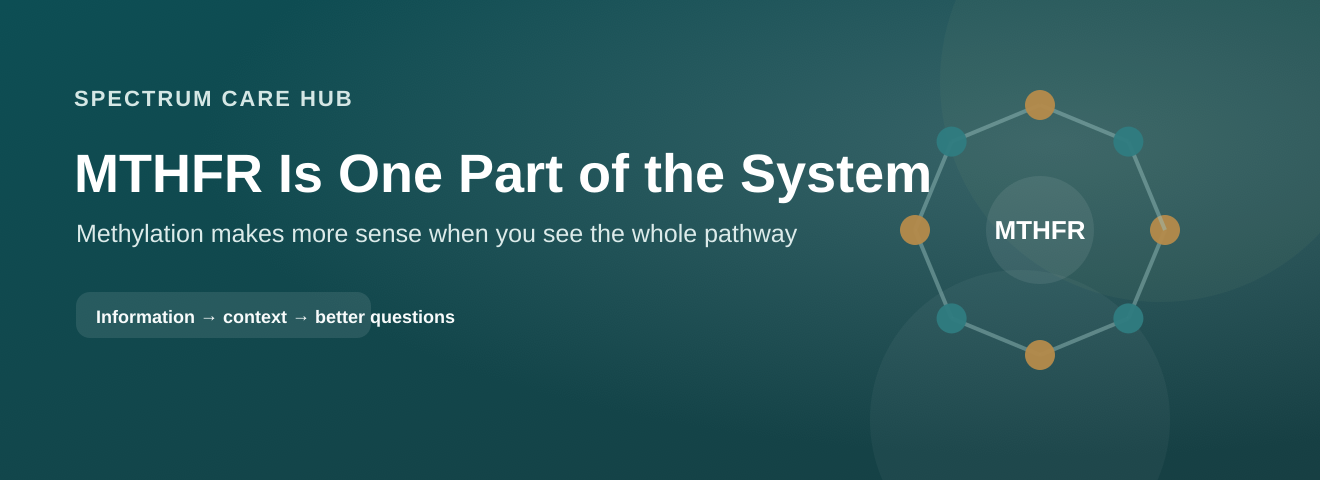
MTHFR is a gene that helps the body process folate within a larger methylation network. A common MTHFR variant may change enzyme efficiency, but it does not prove that a child has a methylation problem or tell you what supplement or dose they need.
Last reviewed by Mary Margaret Burch, FNP-BC, FMAPS — September 2026
Parents searching for biological explanations often encounter MTHFR early. It appears in genomic reports, supplement discussions, social media groups, and conversations about folate, homocysteine, detoxification, mood, and development. The result is that one gene can begin to look like a master switch.
It is not. MTHFR is important, but it is one enzyme in a network with many inputs and outputs. The presence of a variant is a clue about potential efficiency, not a diagnosis of dysfunction.
Think of methylation like a city transit system. MTHFR is one transfer station. If trains move a little more slowly through that station, the whole city does not automatically shut down. You need to know what is happening across the rest of the system before deciding there is a meaningful bottleneck.
Methylation is a basic chemical process the body uses constantly. It helps regulate gene expression, neurotransmitter production, cell repair, and the processing of compounds including homocysteine. Folate and several other nutrients participate in this network.
Because the network is interconnected, symptoms that people attribute to “poor methylation” are rarely specific. Fatigue, attention problems, mood changes, sleep problems, or developmental concerns can have many causes. A genomic report cannot sort those causes out on its own.
If this framework is clicking for you and you’re tired of piecing things together from random posts and forums, consider joining the Spectrum Care Hub Learning Community. You’ll get full access to step-by-step biomedical coursework, printable tools, and new lessons added every month. Learn more →
If an MTHFR finding appears on a report, the useful next step is not to assume treatment. Ask whether there is a clinical reason to investigate further. That may include reviewing diet, medications, supplement use, family history, and laboratory findings that a clinician considers appropriate.
For some patients, homocysteine or nutrient status may add context. For others, the MTHFR result may not change care at all. This is the part that protects families from buying expensive methylation protocols because a report turned one box yellow or red.
Test only when the result could change a decision. Address a confirmed problem with professional guidance. Observe the specific outcome you expected to change. Decide whether the intervention earned a place in the plan.
Folate-related supplements come in different forms, and children can respond differently. A genomic result does not establish the right product, dose, or timing. Supplements can also interact with medications or create problems when used without a clear reason.
If a clinician believes folate support is appropriate, the conversation should include what finding is being treated, what outcome will be monitored, how long the trial will last, and what would make you stop or change the plan. That is a clinical experiment with boundaries, not an open-ended supplement commitment.
If your child has an MTHFR variant, you have information — not a sentence. Do not let the result become an explanation for every symptom. Use it to ask a narrower question: is there evidence that this pathway is relevant to the problem we are trying to solve?
If the answer is no, it is reasonable to leave the finding alone. Not every genetic clue needs an intervention.
This section is for education only. These are examples of questions you might consider raising with your healthcare provider. They are not instructions for self-directed intervention.
Why this works: It asks the clinician to connect genotype to the current clinical picture.
Why this works: It brings non-genetic evidence into the decision.
Why this works: It turns supplementation into a monitored trial rather than an indefinite expense.
Why this works: It makes safety part of the decision before the product is purchased.
If this helped you see your child’s behavior and biology in a new light, the next step is to keep building on that clarity. Our Spectrum Care Hub subscription gives you the complete course library, deeper dive modules, and ongoing support, so you don’t have to navigate autism and PANS/PANDAS care alone. Join the learning community →
It means a version of the MTHFR gene differs from the reference sequence and may change enzyme efficiency. It does not automatically mean disease or that treatment is needed.
No single common MTHFR variant explains autism. Autism has complex genetic and non-genetic contributors, and MTHFR findings should not be treated as a standalone cause.
No. A variant alone does not establish a need for methylfolate or any specific dose. That decision should be based on the full clinical picture and professional guidance.
Certain MTHFR variants can influence folate metabolism and may contribute to homocysteine differences, but diet, vitamin status, medications, kidney function, and other genes also matter.
No. Methylation participates in many biochemical processes and is sometimes discussed within broader detoxification pathways, but the terms are not interchangeable.
Usually not. Symptoms attributed to methylation are nonspecific. A clinician may use history, diet, medication review, examination, and selected laboratory data to decide whether further evaluation is useful.
This article is for educational purposes only. It does not constitute medical advice and does not create a provider-patient relationship between the reader and Mary Margaret Burch, FNP-BC, FMAPS, or Spectrum Care Hub LLC. Do not use this article to self-diagnose, self-treat, or make decisions about your child’s care without consultation with a qualified, licensed healthcare provider. Do not start, stop, or change any treatment, medication, supplement, or therapeutic intervention based on this content alone.
Individual children vary significantly in their biology, presentation, and response to interventions. Research findings describe groups and do not predict what will happen for any individual child.
Last reviewed by Mary Margaret Burch, FNP-BC, FMAPS — September 2026.
© 2026 Spectrum Care Hub LLC. All rights reserved. Content is protected under 17 U.S.C. § 101 et seq. Personal, non-commercial use only. Unauthorized reproduction or redistribution is prohibited.