

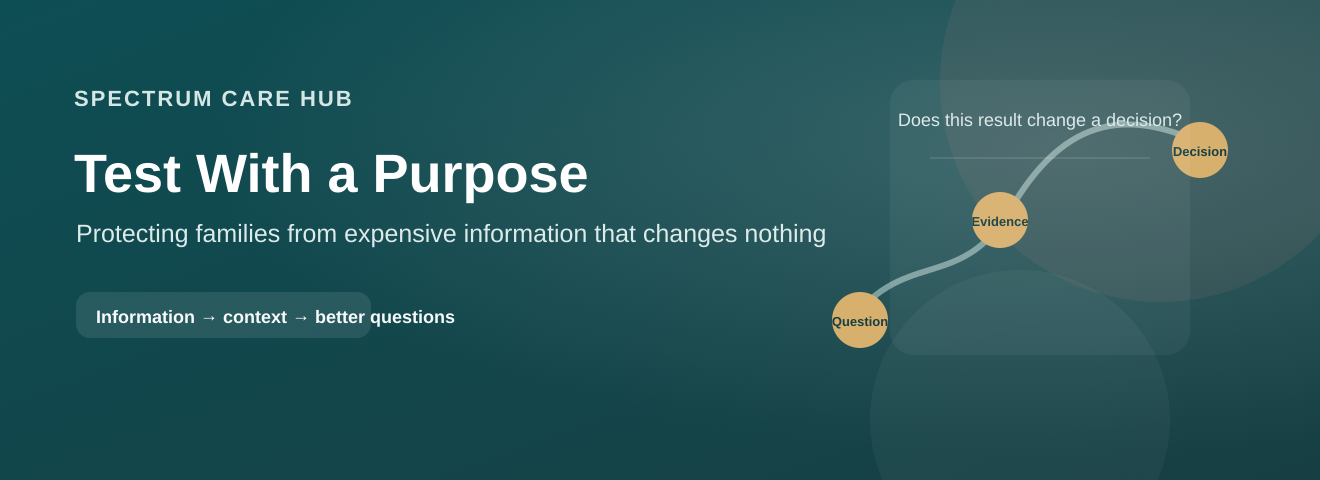
Nutrigenomic testing looks at genetic variants that may influence how the body handles nutrients or related biological pathways. Its value depends on whether the results answer a real clinical question and lead to a reasonable, evidence-matched decision — not on how many variants a report can highlight.
Last reviewed by Mary Margaret Burch, FNP-BC, FMAPS — September 2026
When standard answers have failed, a test promising personalization is appealing. The problem is not that personalization is bad. The problem is that a long report can create the feeling that every result requires action.
That is how a few hundred dollars for testing can become months of specialty labs, supplement stacks, repeat consultations, and products that were never tied to a clear outcome.
A useful test should reduce uncertainty. If it creates twenty new problems without helping you rank them, it may increase burden instead.
Before ordering nutrigenomic testing, write down the decision you hope the result will help make. Are you trying to understand repeated medication side effects? A nutrient deficiency that keeps returning? A family pattern? A laboratory abnormality that has not made sense?
If the answer is simply “I want to know everything,” pause. Genomic reports can generate more information than a family or clinician can use responsibly at one time.
If this test comes back exactly as expected, what will we do differently? If no one can answer that before the test is ordered, the result may not be actionable enough to justify the cost right now.
If this framework is clicking for you and you’re tired of piecing things together from random posts and forums, consider joining the Spectrum Care Hub Learning Community. You’ll get full access to step-by-step biomedical coursework, printable tools, and new lessons added every month. Learn more →
Consumer-style reports often use colors, risk labels, or pathway scores to make complex information readable. Those design choices are useful for organization, but they can also make normal human variation look alarming.
A variant may be common in the population. Its effect may be small. The research may come from adults while your patient is a child. The effect may matter only under certain dietary or medication conditions. Or the finding may be statistically associated with a trait without being useful for an individual decision.
The more pathways a report covers, the more important interpretation becomes.
Sometimes the most useful next step is already in the chart. A careful diet history, medication timeline, family history, symptom tracker, or previous laboratory result may tell you whether a genomic pathway deserves attention.
That is not anti-testing. It is sequencing the work intelligently. The goal is to spend the family’s money where it has the highest chance of changing care.
If you are considering a nutrigenomic panel, ask for a sample report and ask who will interpret it. Ask whether the interpreter has clinical training and whether they will review the result alongside the medical history rather than in isolation.
Then set a limit: choose the one or two findings most connected to the current problem. Do not try to “fix the report.” Your child is not a collection of SNPs. The report should serve the child, not become a new full-time job for the family.
This section is for education only. These are examples of questions you might consider raising with your healthcare provider. They are not instructions for self-directed intervention.
Why this works: A test has more value when everyone agrees on the clinical question before the result arrives.
Why this works: It separates higher-confidence findings from interesting but weak associations.
Why this works: It protects the family from paying for data that will not change the next step.
Why this works: It prevents the report from turning into an expensive checklist.
If this helped you see your child’s behavior and biology in a new light, the next step is to keep building on that clarity. Our Spectrum Care Hub subscription gives you the complete course library, deeper dive modules, and ongoing support, so you don’t have to navigate autism and PANS/PANDAS care alone. Join the learning community →
It examines genetic variants that may influence nutrient metabolism or related pathways. It is different from diagnosing a genetic disorder and usually requires cautious clinical interpretation.
The evidence is not strong enough to say that broad nutrigenomic testing improves autism outcomes as a general strategy. Specific genetic findings may still be useful for specific clinical questions.
There is no single right amount. The better question is whether the test is likely to change a decision and whether less expensive information could answer the same question first.
No. Most reports contain many variants, and many will not be relevant to the current clinical problem. Prioritize findings that match symptoms, history, or other evidence.
Ideally, a qualified clinician or genetics professional who understands the limits of the specific test and can interpret it with the medical history, medications, family history, and other findings.
It can when it narrows a real clinical question or prevents repeated trial-and-error. It can also increase costs if every flagged pathway triggers new tests and supplements without a clear plan.
This article is for educational purposes only. It does not constitute medical advice and does not create a provider-patient relationship between the reader and Mary Margaret Burch, FNP-BC, FMAPS, or Spectrum Care Hub LLC. Do not use this article to self-diagnose, self-treat, or make decisions about your child’s care without consultation with a qualified, licensed healthcare provider. Do not start, stop, or change any treatment, medication, supplement, or therapeutic intervention based on this content alone.
Individual children vary significantly in their biology, presentation, and response to interventions. Research findings describe groups and do not predict what will happen for any individual child.
Last reviewed by Mary Margaret Burch, FNP-BC, FMAPS — September 2026.
© 2026 Spectrum Care Hub LLC. All rights reserved. Content is protected under 17 U.S.C. § 101 et seq. Personal, non-commercial use only. Unauthorized reproduction or redistribution is prohibited.